

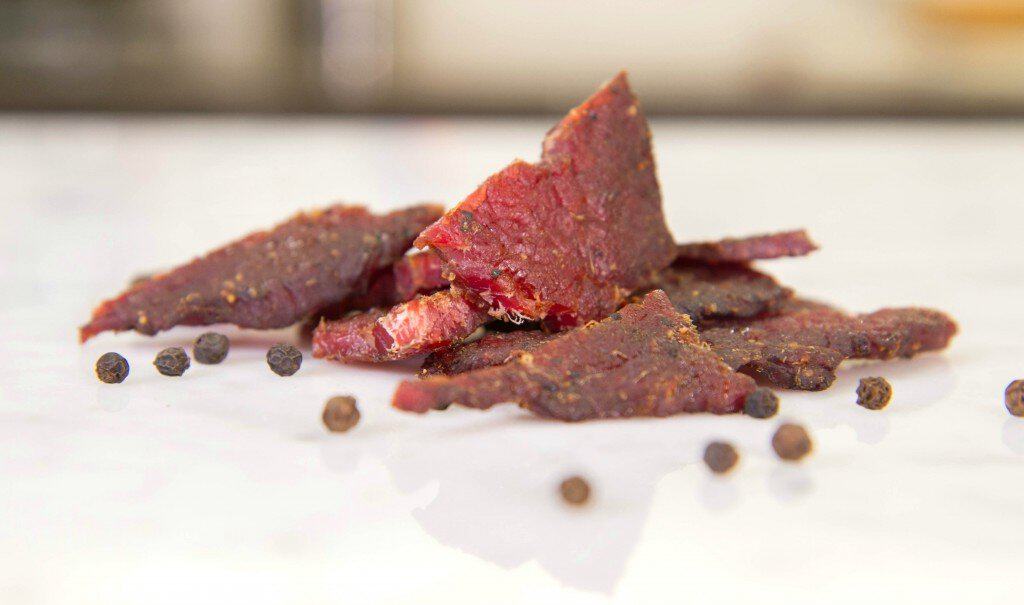
If you’ve never made beef jerky before, now is the time—it’s easier than you think! It’s a simple process, you can use your own smoker, and it tastes better and costs less than what you can buy at a store. Preparing beef jerky at home that’s guaranteed to be safe to eat can be tricky, but we have a recipe, expert tips, and the thermal secrets you need for beef jerky success!
Preserving meat is an ancient practice to utilize every part of the animal. Today’s beef jerky is delicious, practical, and convenient. Since it doesn’t require refrigeration, it’s ideal for campers, backpackers, any outdoor enthusiast, or anyone who needs portable, shelf-stable, nutritionally-dense food.
Top 7 Tips for Perfect Beef Jerky
In his book, Project Smoke, BBQ expert Steven Raichlen shares 7 key tips for beef jerky success.
- Use lean cuts of meat with very little connective tissue such as top or bottom beef round. Fatty meats turn rancid quickly and will shorten the shelf life of your jerky.
- Cut the meat into thin slices. 1/8 to 1/4-inch (1/3 to 2/3-cm) slices work best. Partially freeze the meat for easy slicing (about an hour in the freezer), or have your butcher slice it for you.
- You can turn any type of meat into jerky! Beef is the most popular, but you can make jerky with venison, moose, mule deer, antelope, elk, rabbit, and bison.
-
Heat to a food-safe temperature of 150-160°F (71°C).
- When making turkey or chicken jerky, be sure it reaches a food-safe temperature of 165°F (74°C).
- Drying meat requires low temperatures (160-180°F [71-82°C]). A low drying temperature is crucial. If the environment is too hot, the exterior of the meat will form a crust that does not allow the interior moisture to evaporate. This is great for steaks on the grill, but too much heat works against the jerky making process.
- Maintain constant low-temperature heat in your cooker. Electric smokers are great for jerky because they maintain consistent low temperatures very well.
-
Store jerky in zipper-lock plastic bags. Package the jerky while it’s still warm. Condensation will collect in the bag as it cools, softening the meat.

Shelf Stability and Food Safety
Beef jerky is shelf-stable because nearly all of the moisture has been removed. Microorganisms cannot grow in the absence of moisture, so spoilage is diminished. Beef jerky is most commonly prepared by dehydration, cooking in a low-temperature oven, and smoking. The use of curing salts helps to destroy pathogens.
➤ Water Activity
Commercially prepared beef jerky is made in facilities that are monitored by the health department for food safety. They also have the equipment needed to accurately determine water activity. Water activity is the water available in a food product for microorganisms to grow. Shelf stable beef jerky has a water activity level of 0.70 to 0.85.
Most people who make jerky at home judge it to be done at water activity levels higher than 0.85. For this reason, other methods of preparation and testing for doneness must be used to ensure the safety of your dried meats.
Homemade beef jerky is far more likely to cause foodborne illness than store-bought jerky. Thermal denaturation of bacteria (explained below) is the simplest sure-fire way to make sure your food is safe to eat.
How do You Know When Beef Jerky is “Done?”
Jerky can be considered “done” and safe to eat only when it has been heated sufficiently to destroy any pathogens present and is dry enough to be shelf-stable. —Making Jerky at Home Safely, Pacific Northwest Extension
The only way to know if your jerky has been heated sufficiently is with accurate thermometers. The Thermapen‘s® sensor is in the very 1/8-inch of the probe’s reduced tip, making it possible to measure the temperature of thin pieces of meat like jerky.
For proper heating and drying, monitor the internal temperature of your smoker with an alarm thermometer like the ThermoWorks® ChefAlarm® with a Pro-Series® Air Probe and Grate Clip.
Safely Making Jerky Without a Smoker
If you’re using a food dehydrator that does not reach the temperature range of 160-180°F (71-82°C), you can still ensure its food safety with a quick additional step.
➤ Post-Drying Heating
After your jerky is completely dried, heat it in a 275°F (135°C) oven for ten minutes. Spot-check the internal temperature of your jerky with a Thermapen to be sure it’s reached a temperature of 150-160°F (66-71°C). With this final, quick step you can be sure your jerky is pathogen-free.


0 comments