

Baked chicken breasts are a quick, easy solution for dinner—but how many times do they turn out dry, rubbery, and nearly flavorless? No matter how good your sauce is, dry overcooked chicken is never good to eat. But there are a few tricks to cooking tender, juicy chicken breasts every time—regardless of the recipe you use. Keep reading for the temperature tips you need to get it right.
Chicken breasts account for 60% of the chicken sold in stores in the U.S., and most of it is boneless and skinless. And while it’s widely recognized that bone-in, skin-on chicken will have more moisture and flavor, so many of us have family members (I’m looking at you, kids!) who prefer not to deal with the skin or bones.
Besides, the stripped-down white meat is so easy to work with. And when boneless, skinless chicken breast goes on sale at the local grocery store, who can resist stocking up the freezer? Boneless, skinless chicken breasts are a staple in so many home kitchens, but there has to be an easy way to get better results!
3 Top Chicken Cooking Challenges:
Why are chicken breasts so notorious for being dry and tough? These three factors make even the slightest error in overcooking very noticeable.
- White chicken meat is very lean. White chicken breast meat has very little fat and nearly no connective tissue, which is problematic because the presence of fat accounts for much of the perception of moisture in meat. Fat also contributes to flavor, and the lack of it in chicken breast means the flavor of the meat is very delicate, so it’s important to retain the moisture and flavor that naturally exists in the meat. The best way to do this is to cook it to the proper temperature. Overcooking leads to dry, tough, sawdusty meat with nearly no flavor.
- High doneness temperature for food safety. Salmonella is the food safety enemy in chicken that dies only at higher temperatures. But cooking chicken breast to an instant thermal-kill doneness temperature will cause it to dry out excessively. Even slight overcooking is apparent in chicken breast because it is so lean. Tracking and verifying temperatures is critical to cooking juicy chicken that is also safe to eat.
- Its shape is uneven. The naturally uneven shape of a chicken breast makes it difficult for the entire piece of meat to be perfectly cooked at the same time. The thin, tapered end will be sadly overcooked and dry by the time the thermal center of the fatter end has reached its pull temperature.
So what are we to do?
3 Simple Keys to Juicy Baked Chicken
A few simple steps will set you up for juicy chicken success.
1. Brine It…If You Have The Time
A wet-brined chicken breast will absorb some of the water during the brining time, but will still end up losing quite a bit of moisture while cooking—nearly the same amount as dry-brined chicken. So either method should produce similar results.
Brining in Water: Brining is the process of soaking meat in a salt water solution. Over time, the salt not only seasons the meat, but it alters the protein on the outer edge of the meat making it better able to retain its own moisture through the cooking process. Some of the water is absorbed by the meat for a juicier end result.
Dry Brining: Dry brining is the process of seasoning the meat with salt on all sides and allowing it to rest for at least 30 minutes—and up to overnight— with the salt on it before cooking. Salt is hygroscopic (or water-loving) and draws moisture to the surface of the meat. The salt dissolves in this moisture and is then drawn into the meat. The same chemical reaction occurs with dry brining as in wet brining, and the protein is able to retain moisture better during cooking.
Brining is best, but you may not have time for that on a busy night. If you can’t brine, be sure to season the chicken on all sides, not just a quick sprinkling of salt on the top.
➤ Take away: brined chicken will be more moist and juicy than chicken that is not brined. A 30-minute dry brine will improve the eating quality of your chicken dramatically.
2. Flatten It Out
Chicken breasts are an uneven teardrop shape, fat and thick at one end, tapered and thin at the other. The tapered end will finish cooking much faster than the thick end and will be overcooked and dry by the time the entire piece of meat has come to its pull temperature. To overcome this problem, the best thing to do is flatten the chicken breast by pounding it out.
Note, though, that the thinner you pound it, the faster it will cook, meaning it might overcook if not properly monitored. So pound it until it is basically even, but no thinner and then be sure to monitor the cooking temps!
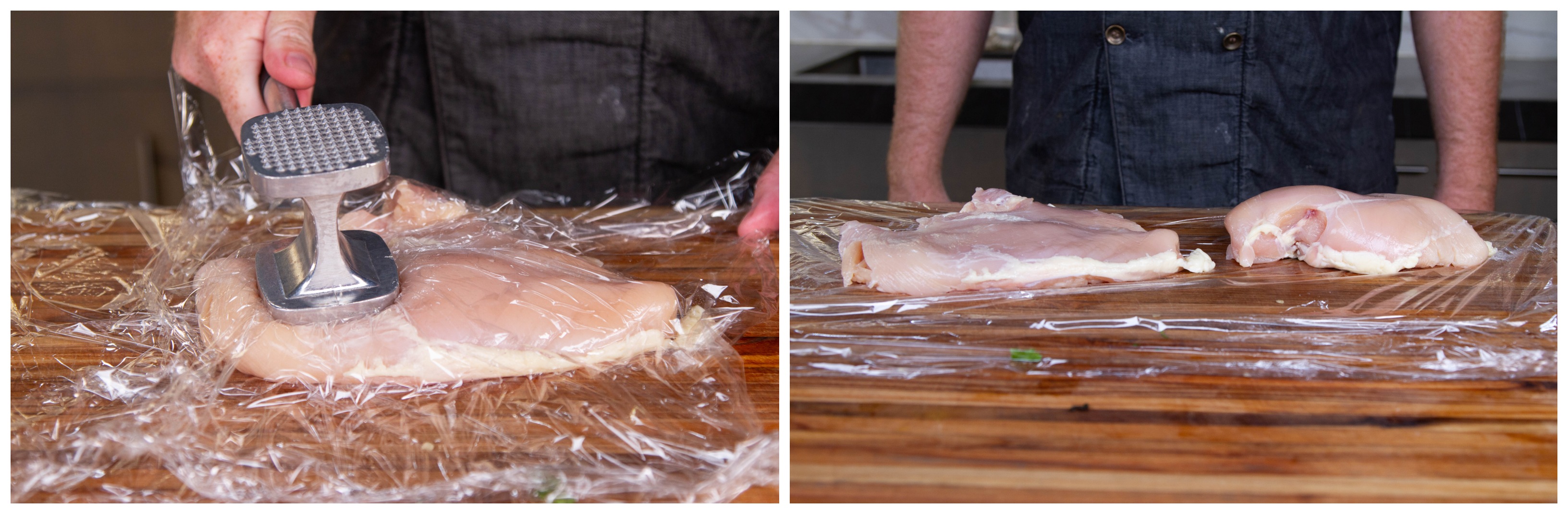
➤ Tasty bonus: The pounded-out chicken breast will have more exposed surface area. That means more area for a flavorful seasoning and browning.
3. Track the Temperature, Then Verify
There are so many variables that play into exactly how long it will take your chicken to cook: oven temperature, oven accuracy, the size of the chicken breasts, the type of pan you’re cooking in, the temperature of the chicken, etc. It’s important to pull the chicken from the oven once as soon as it reaches its target temperature, and not a degree later. If it’s pulled at too high of a temperature, the chicken will be dry and tough.
Use a leave-in probe oven thermometer like a ChefAlarm® to track the internal temperature of the chicken as it cooks. DOT’s high alarm will sound when the target pull temperature is reached, then you can verify its internal temperature with an instant-read digital thermometer like the Thermapen® Mk4.
➤ Pull the chicken at its doneness temperature, and not a degree higher.
…buy a digital instant-read thermometer. You will never over- or undercook a piece of meat again. Do it. no more excuses, no more timing charts or poking with your fingers. Just buy a good thermometer, and don’t look back. I guarantee you will not regret it. …the Splash-Proof Thermapen from ThermoWorks is pricier than most, but it will last forever and it more than meets all the essential criteria. —The Food Lab, J. Kenji Lopez-Alt
What Happens to Chicken As It Cooks: Chicken Temp Matters
Significant changes occur in this white meat during the cooking process. In the image below you can see the changes that occur with texture, shrinkage, and loss of moisture as the internal temperature climbs. Temperatures beyond 160°F (71°C) are where the meat becomes irreversibly dry and tough. Temperature tracking is critical. For more information on exactly what’s going on with protein fibers during the cooking process, see our post Heat and Its Effects on Muscle Fibers in Meat.
➤ How Long to Cook Chicken: Until It’s Safe!
The USDA recommends cooking chicken to an internal temperature of 165°F (74°C) to eliminate salmonella and campylobacter bacteria. At this temperature, pasteurization is nearly instantaneous. However, if chicken is held for specific periods of time at lower temperatures, the same level of pasteurization will result as if the chicken had been cooked to 165°F (74°C).
What the USDA is looking for is a 7-log10 relative reduction in salmonella bacteria in the meat. That means that out of every 10,000,000 bacteria living in a piece of chicken, only one will survive. In the table below you can see how long meat needs to be held at specific temperatures for proper food safety.
Leave your thermometer’s probe in the meat after you remove it from the oven so you can see the temperature rise with carryover cooking. You can use a timer to be sure the final doneness temperature or above is held for the appropriate amount of time.
USDA Times and Temperatures to Obtain 7-log10 Lethality of Salmonella
| Temperature | Holding Time |
| 140°F (60°C) | 35 minutes |
| 145°F (63°C) | 13 minutes |
| 150°F (66°C) | 4.2 minutes |
| 152°F (67°C) | 2.3 minutes |
| 155°F (68°C) | 54.4 seconds |
| 157°F (69°C) | 34 seconds |
| 160°F (71°C) | 16.9 seconds |
| 162°F (72°C) | 10.5 seconds |
| 165°F (74°C) | <10 seconds |
Chicken doneness temp
We pulled our chicken at 157°F (69°C) and had a final doneness temperature of 160–161°F (71–72°C). The chicken only needs to maintain that pull temperature for 34 seconds to be safe enough to eat, which it actually surpasses in the carryover cooking. Pulling the chicken breast at the right temperature is what yields succulent, juicy meat.
Threefold Criteria for Tasty Chicken
What are we looking for in delicious chicken?
- Texture: Tender, not tough. The higher the doneness temperature, the tougher the meat fibers will become.
- Moisture: Juicy, not dry. Meat fibers expel more moisture at high doneness temperatures. Accurate temperature tracking and pull temperature are critical.
- Flavor: Sufficient seasoning and/or richness from the Maillard reaction. Browning on the surface of the chicken imparts flavor, but is not needed for every recipe.
Overcooking a thin piece of meat such as a butterflied chicken breast is easy without careful temperature tracking. Mind your temps to achieve the juiciest result.

0 comments