

In my earlier life, I was a musician and a physicist. Music, science, and food are still my great loves in life, but that initial training has made some things in cooking more difficult. You see, in physics there is a right answer. You can do the math a few different ways, but even within those varied pathways, there are rules that point the way forward. Music was the same: follow the conductor, play the notes as written, remember the rules of harmony and music theory. Jazz was not my forte.
This personal reliance on rules and direction has caused no problem for me with “classical” cuisines in cooking. (Read: “western European cooking.”) But then there is barbecue, which is—more than any other mode of cooking—improvisational jazz.
Line up three expert pitmasters and grill them on technique, temperature, smoke, wood, fuel, wrapping, resting, or bark and you’ll get three different answers. You’ll pick up on themes—chord changes, if you will—but not “right” answers. At first, it was hard for me to adjust to. But now I understand that the placement of the water pan, the time you spritz or wrap, whether you use charcoal or plain wood for heat, or the sugar content of your rub—those are all stylistic differences, flairs and trills on a theme with one persistent beat: low heat plus time, low heat plus time, low heat plus time.
In the end, the most important factor in your barbecue success is the final state of the meat’s collagen/gelatin transformation. Not enough time in the melting-zone and you get tough, chewy, regrettable BBQ—the kind your uncle makes that he’s so proud of and that everybody eats out of politeness. Too much time in the melt zone and you get fall-apart BBQ that can start to dry out and that, while still tasty with a little sauce, isn’t going to win any awards.
In today’s post, we intend to walk you through the whole brisket process, including some of the methods that are used by amateurs and professionals alike to help you navigate your way to some fantastic brisket. After all, May is National BBQ Month (did we mention that?). And you can do this.

Difficulties of cooking beef brisket
Two muscles: what is brisket?
One of the reasons that brisket is known as the king of BBQ meats—aside from the fact that it’s packed with delicious, almost sweet-tasting fat—is that it’s hard to get right. To make perfect brisket, you have to surrender: you do what it says for 8–16 hours. Not what you planned. Stoke the coals at 3 a.m? Do it. Stay up an extra hour to let the bark set before you wrap? Yes. Put the potato salad back in the fridge and try to think of things to talk about with your brother-in-law for the 2 more hours than you expected to get this thing just right? That’s the price of perfection. Those that master brisket are great pitmasters, indeed. But they have also learned how to be patient.

What makes brisket so difficult to cook, though? The very muscle itself. A whole brisket (full packer) is actually composed of two different muscles: the flat and the point. They are separated in the brisket by a thick layer of fat (the deckle) and cook at different temperatures. The flat is relatively lean and prone to overcooking, while the point is marbled with fat, which requires long cooking to render properly. Add to this the fact that the point is stacked on top of the flat—well, really, half the flat—and the thermal conundrum of how to properly cook brisket comes more sharply into focus.
For instance, where should we put the thermometer? If we place it in the true thermal center of the meat (between the point and the flat), we’ll overcook the flat. If we cook the point to the standard BBQ pull temp for tough meats—203°F (95°C)—the flat will likely be toast. (Spoiler: put it in the flat.)
Toughness/tenderness and time
But the two-muscle problem isn’t the only puzzle the brisket demands we solve. Brisket is also—thanks to its active position on the breast of the cow—positively packed with collagen. This connective tissue must be rendered into luscious gelatin so that the meat is tender, not tough and rubbery/chewy.
Collagen dissolution is, sadly, not just a factor of temperature but also of time. Would that we could just stick a thermometer in the meat and blast it at high heat until it reached 203°F (95°C)! But getting there in an hour will only give us a brisket that is so rubbery that you could almost dribble it down the street. This is why our theme of low heat plus time is so important. And it is why brisket cooking often involves late nights with a flashlight. We have to give the collagen time to break down.
Stall
For those of you that don’t remember your protein science, when meat fibers begin to cook, they contract and expel water that is otherwise bound up in them. This is what causes meat to dry up when overcooked. In the case of brisket, as the muscle fibers contract and expel their water, that water acts like perspiration, causing evaporative cooling to take place on the surface of the meat. This cooling literally causes the cooking of the meat to stall. The stall starts at about 150°F (66°C) and runs up through about 180°F (82°C), and those thirty-or-so degrees can take upwards of six hours to get through. For new barbecue cooks, this can be a near-panic inducing time. Why isn’t my brisket cooking?
This stall allows you to practice the art of barbecue patience. As long as you maintain…temperature, your brisket will eventually move beyond this stall, and the meat temperature will rise again”
—Will Fleischmann, southern pitmaster
To make matters worse, the stall starts just below the temperatures where collagen dissolution begins. If only there were some way to get past the stall and into collagen dissolution!
There is. In fact, most of the rest of this post will be devoted to defeating the stall—and the costs of such a victory. But there are a few more things to consider first.
Parameters of brisket perfection
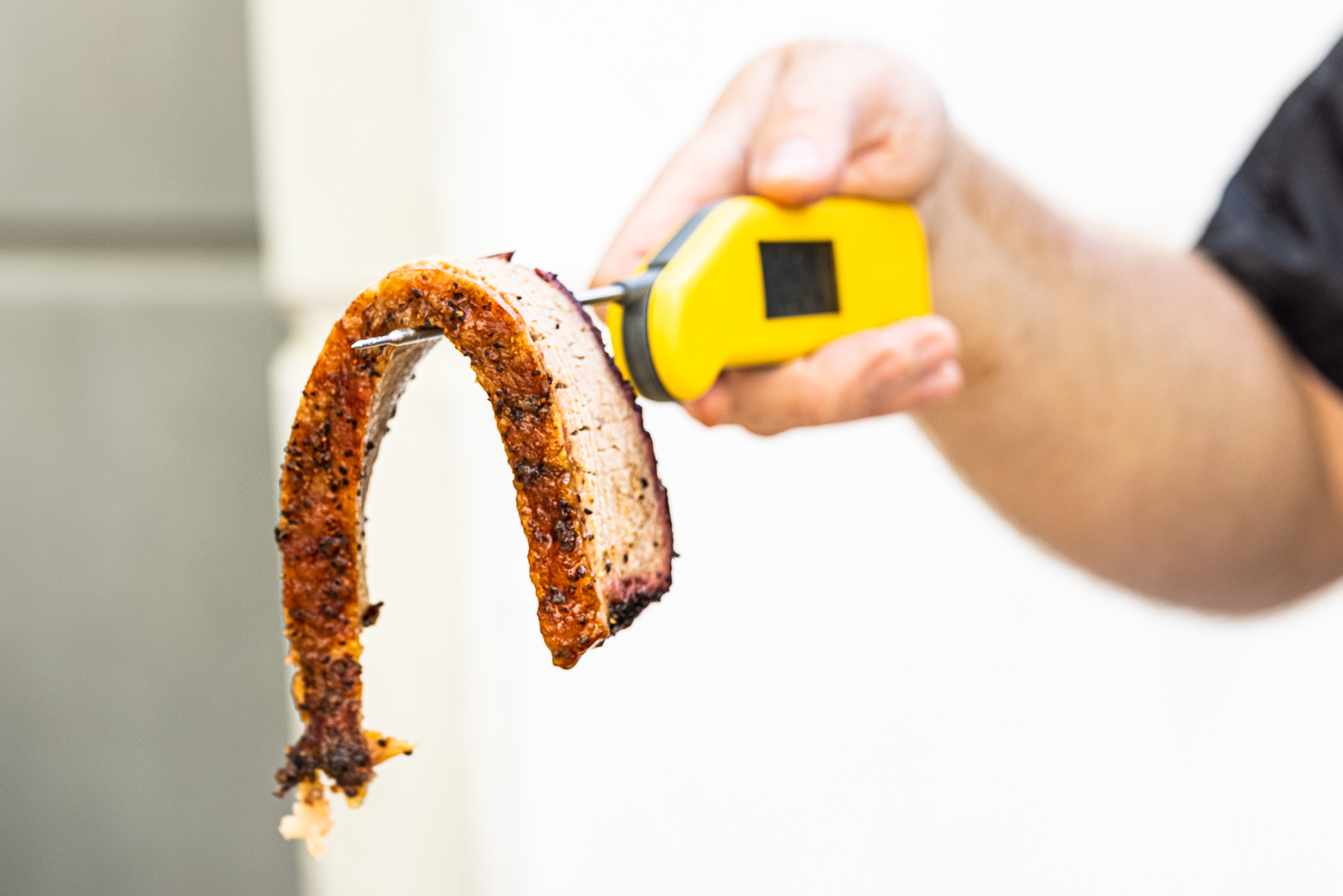
Perfect brisket means different things to everyone, but judges for the Kansas City Barbecue Society look for a very particular brisket doneness. They use what is called the pull test to check for over/undercooking of brisket. For the pull test, a slice of brisket is held up. It should be able to support its own weight without breaking and crumbling, but should be easily pulled apart with a slight tug. To the KCBS judges, if it falls apart on its own then it is overcooked. If it can’t easily be pulled apart, it is undercooked.
To you, that may or may not sound delicious. Perhaps you want absolutely fall-apart brisket. If so, that’s fine, and you can get what you want by simply leaving your meat to cook a little longer—just don’t take it to a KCBS event!
Perfect brisket should also have a good bark. Bark is the crusty, smoky layer of spices that coats a brisket. The rub you use will mix with the juices of the brisket and dry out, creating a delectable crust that is one of the hallmarks of good BBQ. Any brisket method that we use should give us a good bark.
How to smoke a brisket: keys to success
Slow cooking brisket
As we discussed above, the stall is caused by water being squeezed out of the muscle fibers, meaning the meat perspires and cools. So why don’t we end up with dry brisket every time? Because of the collagen! In brisket, the collagen connective tissue unwinds as it cooks into gelatin—which is highly absorbent, holding up to ten times its weight in water. The gelatin in brisket acts as a reservoir, holding on to water that is not bound up in the muscle fibers themselves. After the meat passes “well done” and is dried out, the collagen starts to dissolve, replenishing the meat’s structure with moisture. This is, again, why the low and slow cooking is so important. The meat actually dries out before it becomes moist again.
So the problem of chewiness and dryness is solved by the very fact that we’re cooking this BBQ style. But what of the stall? What if you don’t want to spend 16 hours cooking dinner?
The Texas Crutch
Long ago, legendarily in Texas, some pitmasters found that if they smoked their brisket partially, then wrapped it for the remainder of the cook, they got to their end goal sooner. The stall wasn’t taking as long. The reason for this, unbeknownst to those old-time cooks, is that wrapping the brisket slows evaporative cooling. When the brisket is wrapped in, say, foil, a micro-climate is established. The humidity in the foil quickly reaches 100%, meaning that there is no room for evaporation to take place. No evaporation means no stalling, and you can push right on through the stall without waiting for the meat to wring itself out like a sponge before heating. Called the “Texas Crutch,” this technique is the sworn technique of barbecue cooks the world over.
I always crutch brisket. I think it makes a significant difference.” —Meathead Goldwyn
Crutching methods
The most traditional crutching method is to use aluminum foil, which is non-permeable to water, and thus creates a solid barrier against evaporation.
Other brisket gurus, most notably Aaron Franklin of Franklin BBQ in Austin, swear by peach paper: a type of pink-colored un-coated butcher paper. The idea behind using peach paper is that it creates a non-perfect barrier to evaporation. Some transfer of water can occur through the paper, but not so much as naked evaporation would allow. This theoretically speeds the cooking to some degree and retains some moisture in the meat, while allowing more of a bark to form.
Those who cannot locate peach paper often use packing paper, craft paper, or other uncoated paper. The goal is the same as that of peach paper: less evaporation, more bark, faster cooking.
And, of course, there is always the naked brisket. We’ll be cooking one of each of these and analyzing their outcomes.
Method
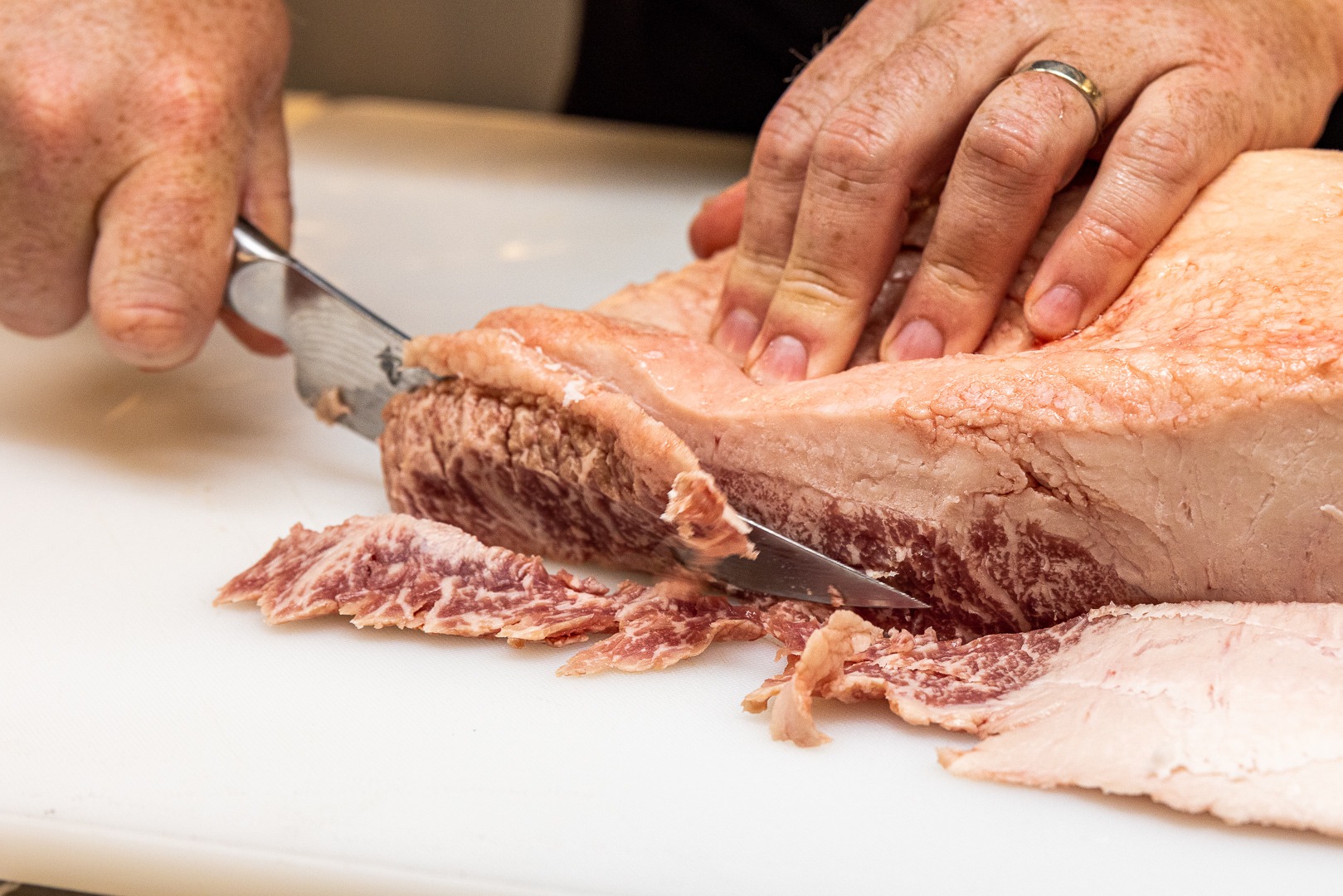
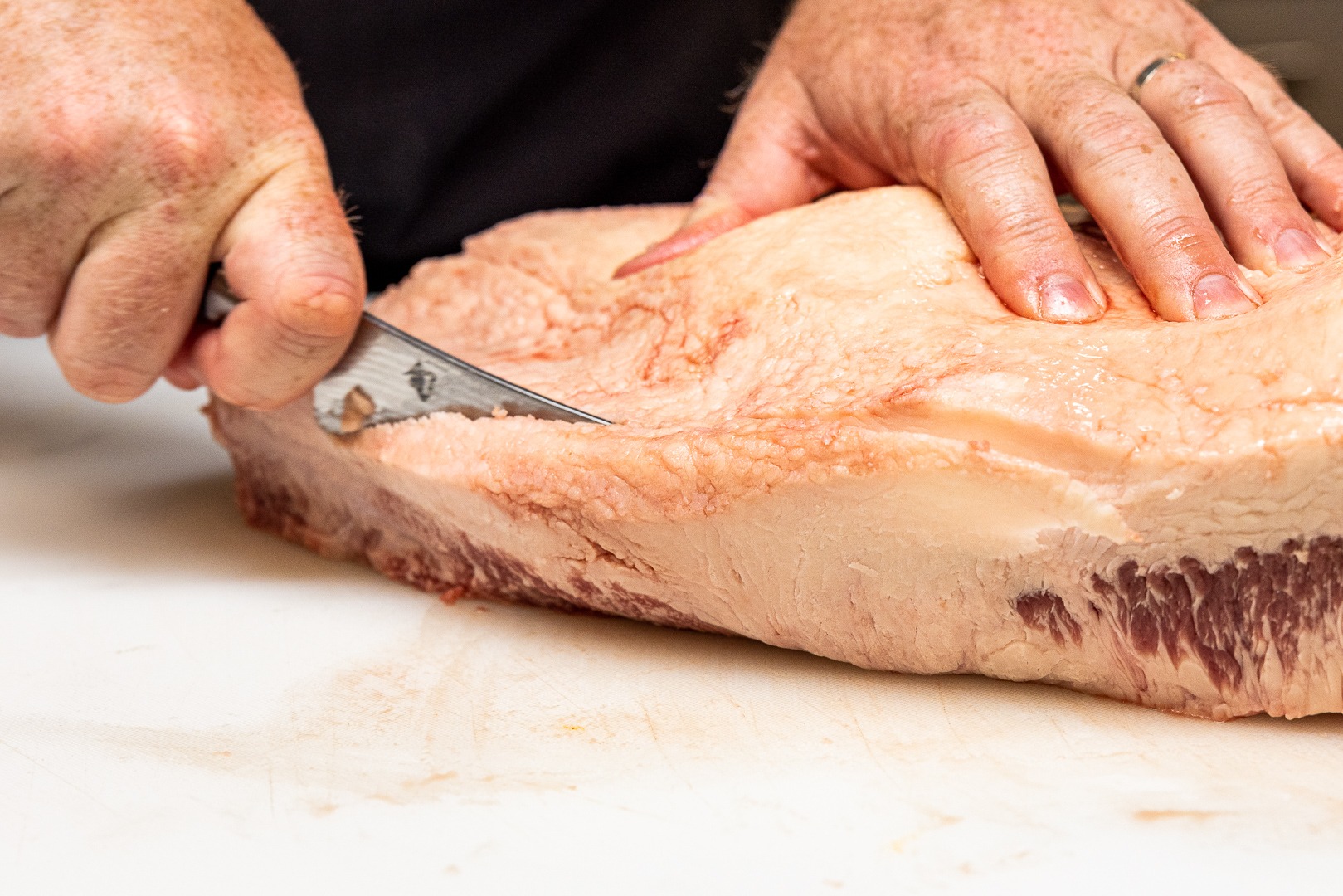
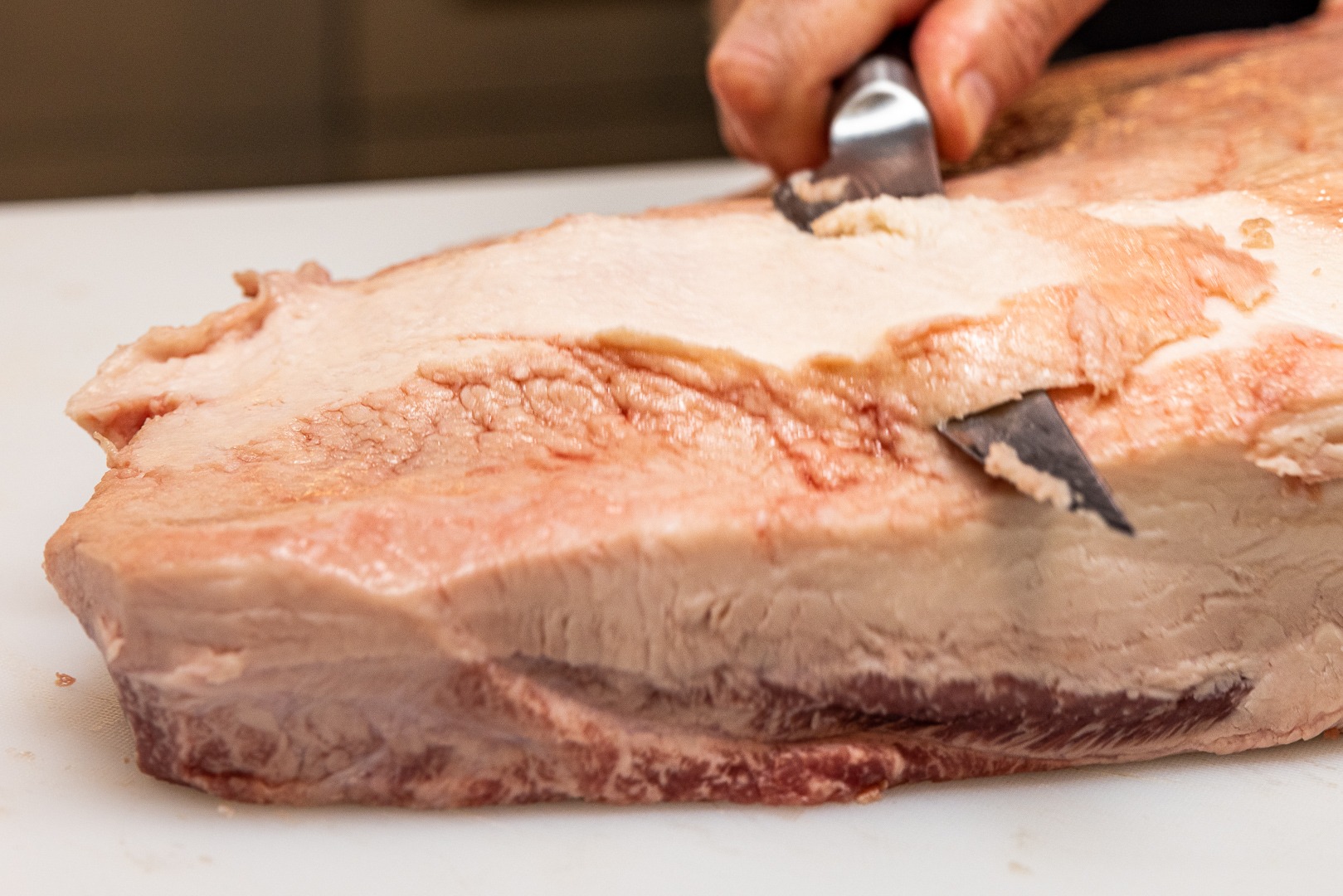
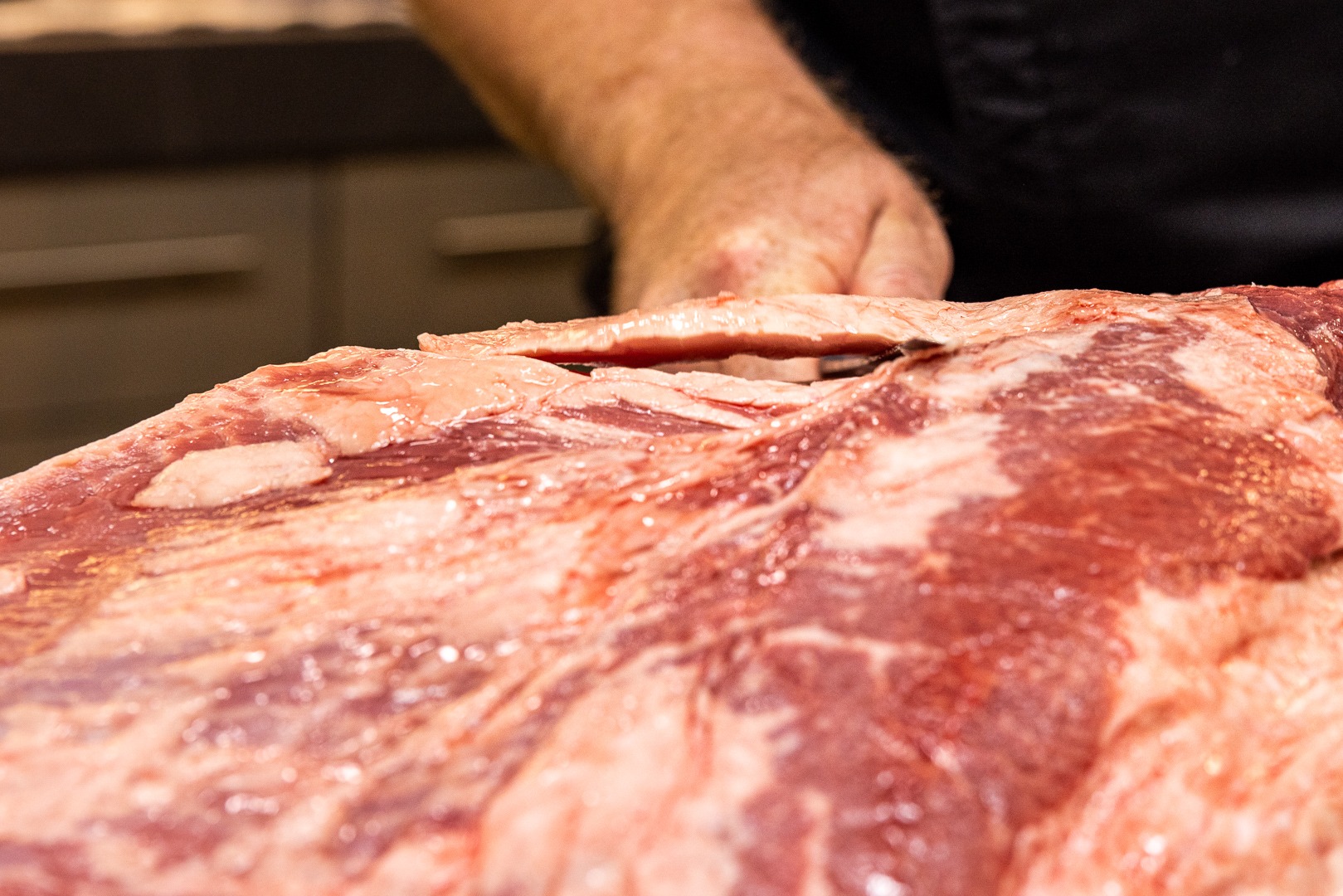
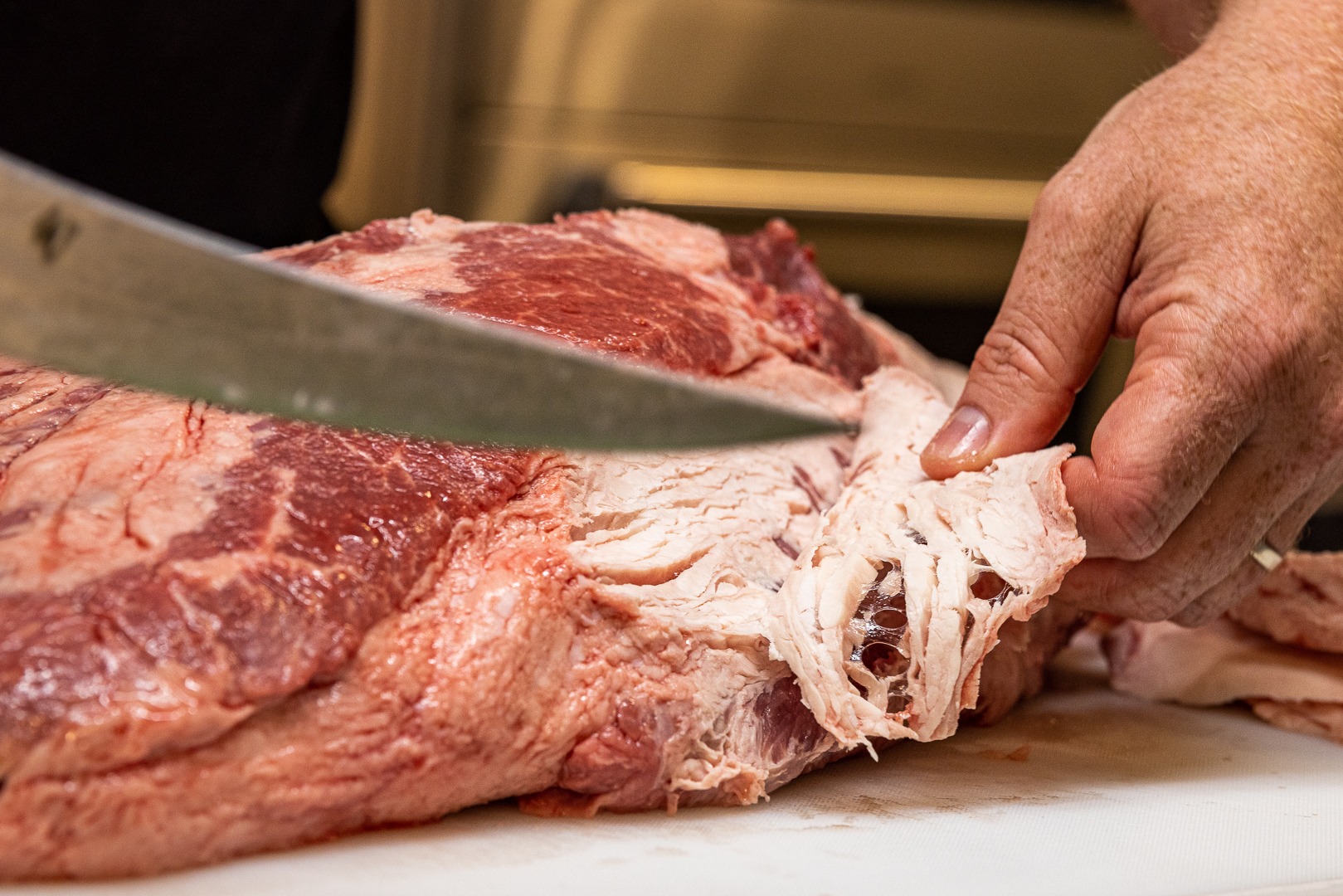
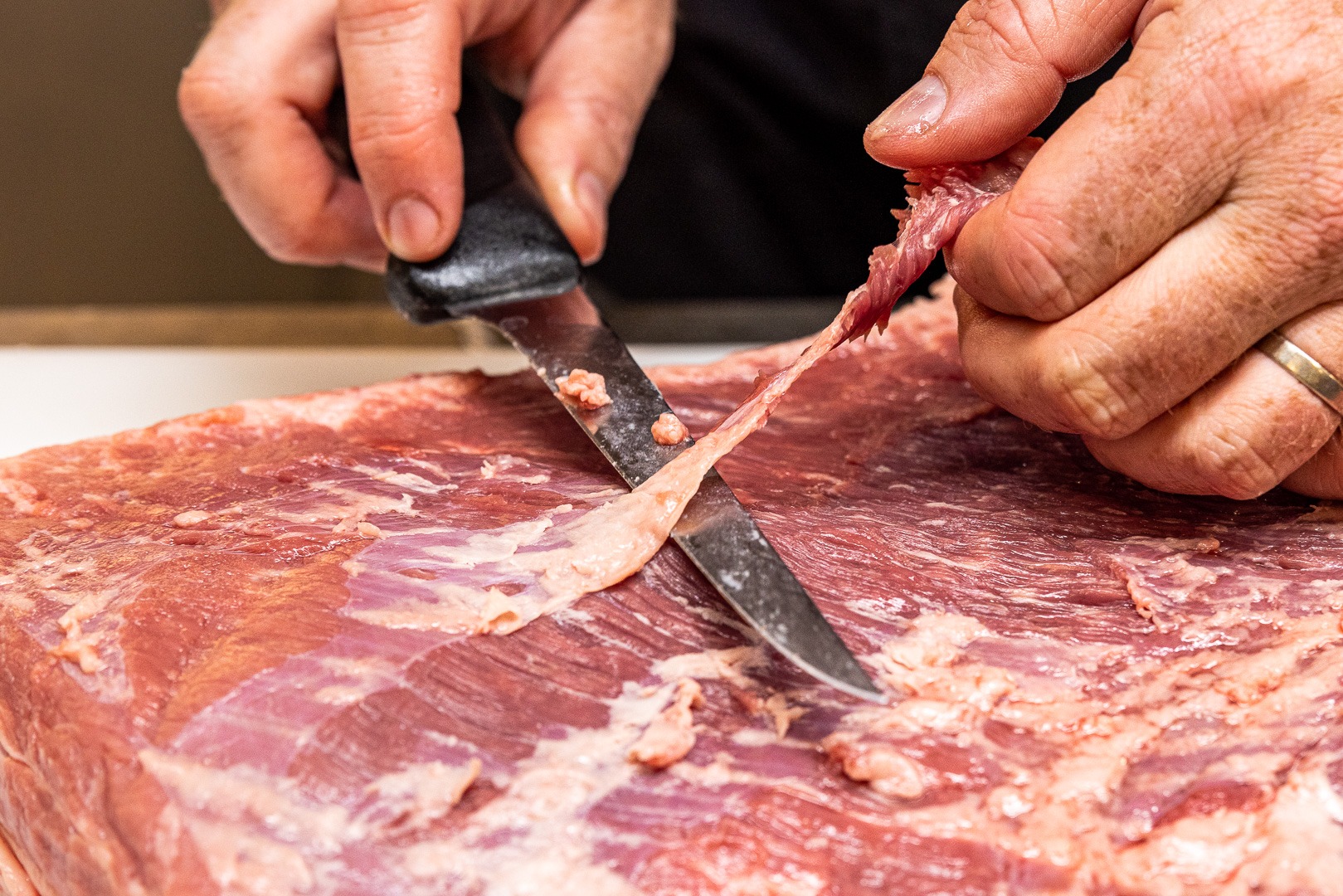
We cooked four briskets, each one with a different crutching method. Each was of roughly equal size (all between 15.5 and 16.5 lbs). They were all cooked on the same cooker, though at different times. Before cooking, each brisket was first trimmed of excess fat and coated in a mixture of equal parts by volume of salt and black pepper—pure and simple.

Cooking brisket three ways: experimental method
Cooking brisket three ways: experimental methodWe cooked one brisket without any crutching, naked. We also cooked one brisket each with peach paper and foil, wrapping them after 4-1/2 hours, at just about the time that an internal temperature of 150°F (66°C) had been reached.
Each brisket had four probes placed in it, two in the point and two in the flat. One, a handsbreadth from the end of the flat, the next a handsbreadth beyond that. In the point, they had the same spacing, starting a handsbreadth from the point-end.
These probes were attached to Signals™, our WiFi-enabled quad-channel thermometer so that we could both monitor the cooks remotely via the ThermoWorks app and record the data for later examination on the cloud. We used a separate Signals to run an air probe and two Billows™ in each cook. Obviously, you don’t need two Signals’ to cook brisket, but we wanted four channels of data plus fan control, so we used two.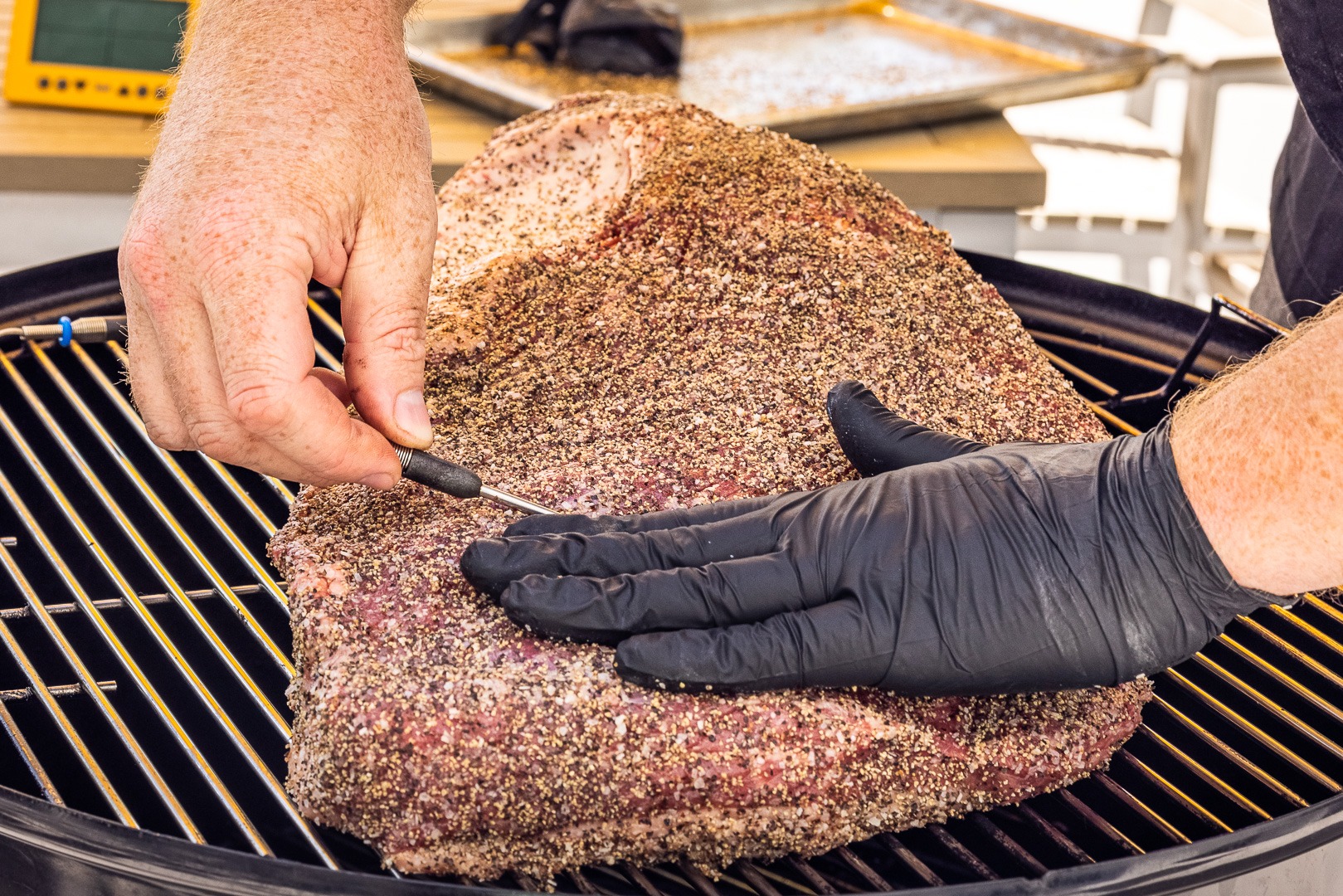
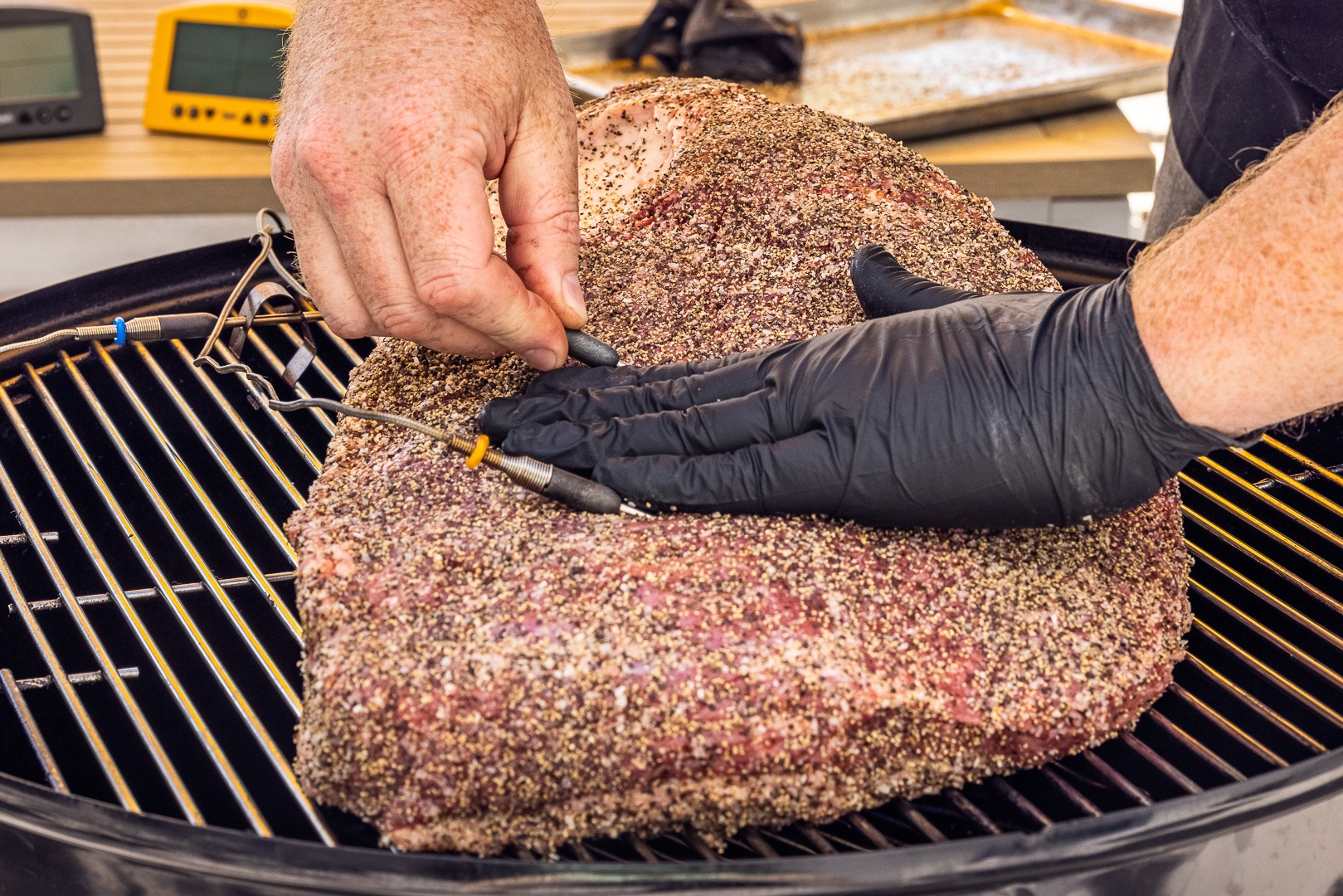
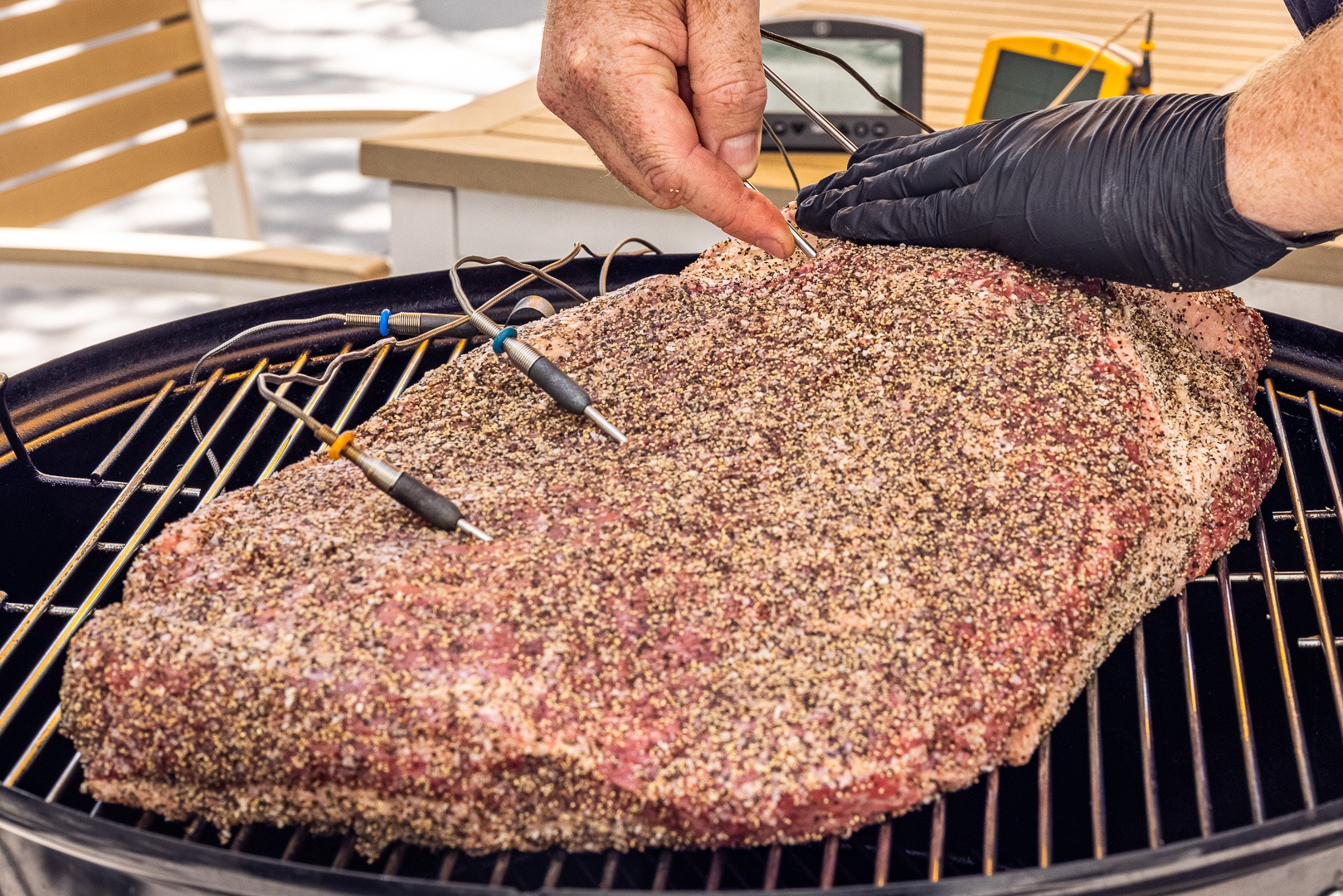
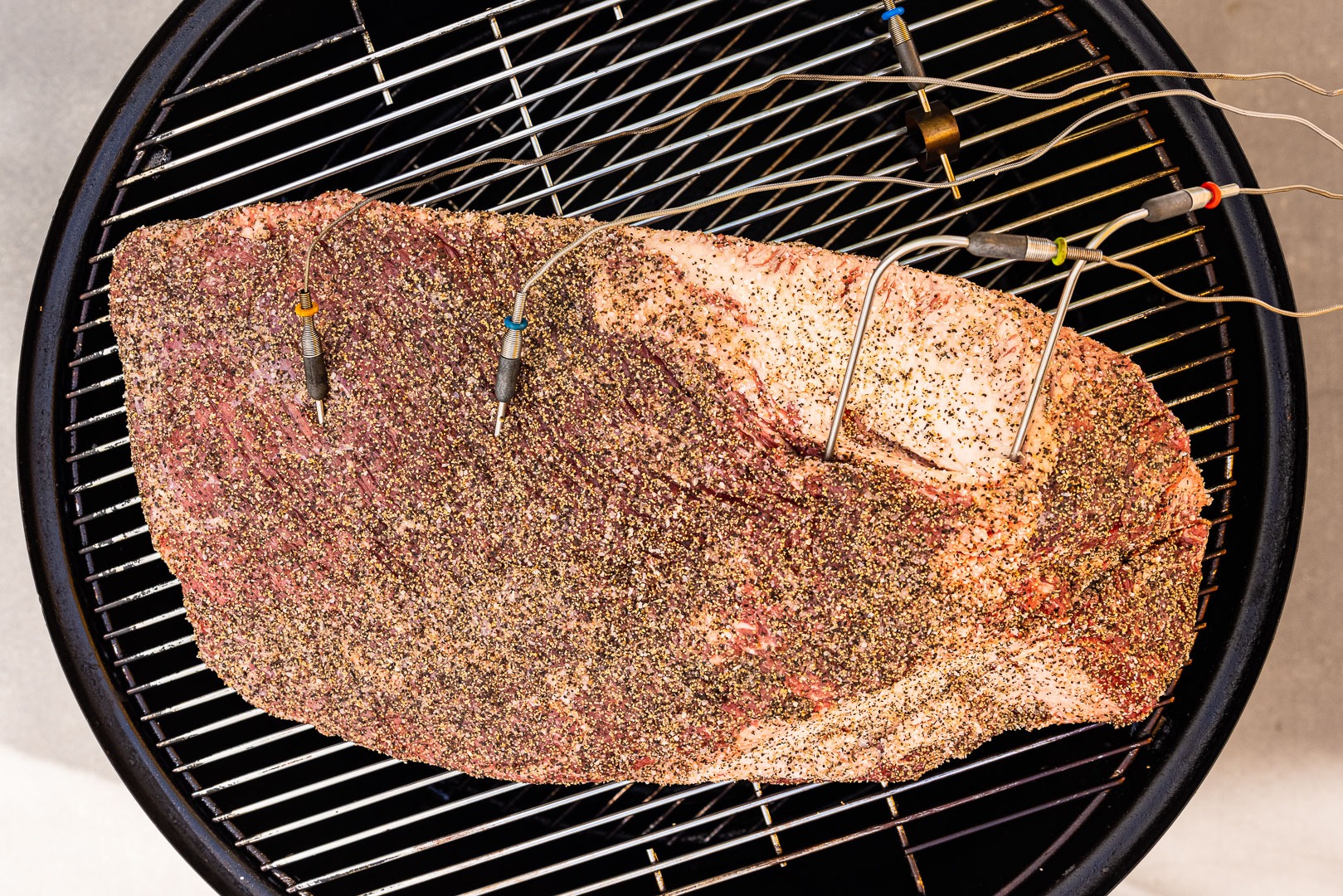
Each brisket was cooked, fat-side down, in the same cooker with two Billows controlling the temperature at 250°F (121°C). (We used two billows to get enough airflow through this rather-large smoker. Most smokers just need one Billows.) We didn’t use a water pan, and each cook got two chunks of applewood for flavor. Our target temp was 200–203°F (93–95°C). Our pull temp was determined based on temperature as well as feel: a Thermapen® was inserted into both the flat and point of each brisket to verify temperature and to feel for tenderness.
After cooking, each brisket was allowed to cool down a few degrees and then put into a closed cooler to rest for one hour before slicing
(Note: If you look at the time markings on these cook charts you can see them going all through the night. I monitored the briskets from my home as they cooked on the ThermoWorks BBQ patio. This tool makes BBQ much easier to deal with, because you don’t have to sit by the pit the whole day or, as the case may be, the whole night long.)
Results: is brisket better wrapped or unwrapped?
Naked brisket: results with no wrapping
The naked brisket—our control for this experiment that was not wrapped—took about 16 hours to cook.

You can see the temperatures taking right off, especially in the thinner flat. By the time three hours had passed, the brisket had pretty much entered the stall. The flat stalled before the point did, which makes physical sense. At about 10 A.M. you can see a slight dip in temperature where we ran out of fuel and had to get more coals going and into the cooker. We lost a little thermal momentum on that, but it did bring all of the temperatures to within a few degrees of each other, which was great.
When we verified temps with the Thermapen at 200°F (93°C), we found the point and the flat to be exceptionally tender.
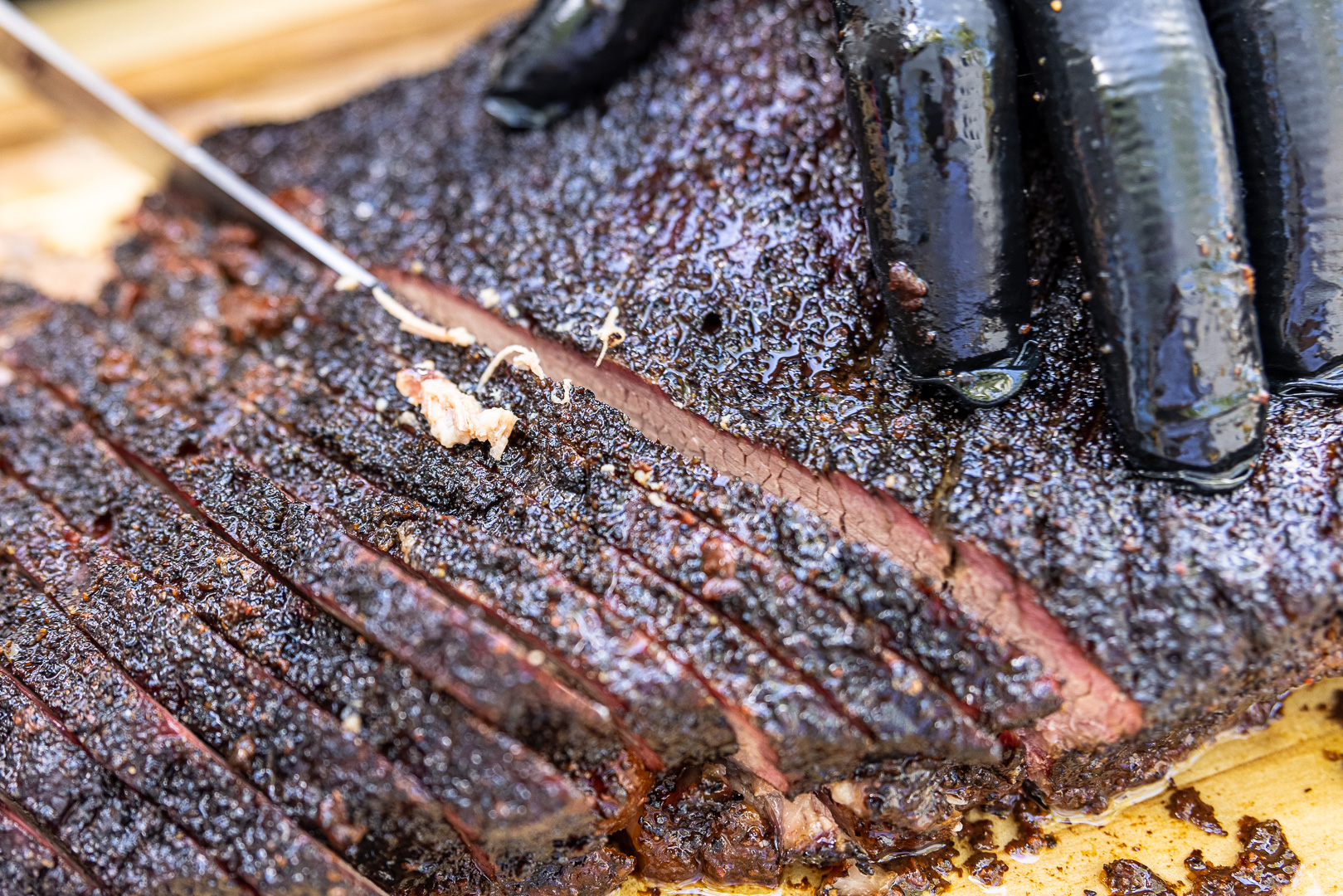
The bark on our naked brisket was crusty, flavorful, and plentiful.

Brisket, bark.
The meat was smoky, tender, and juicy with an almost silken texture in the point. It was, truth be told, the best brisket I’d ever made up to this point in my life. But the moisture in the meat was excellent. The fats had fully rendered. It received very high marks from everyone who ate it. Even the flat, which is sometimes sacrificed for a good point, was tender and deeply flavored. It was, frankly, amazing.


Peach paper brisket:
The brown-paper brisket cooked for 15 hours, not a huge time savings.
You can see that the stall was…lessened. The slope of the temperature curve is greater. We ran out of fuel at the same time again, and lost a little momentum there, but recovered and got to 200°F (93°C), checked it for tenderness, and let it rest as we had the other.
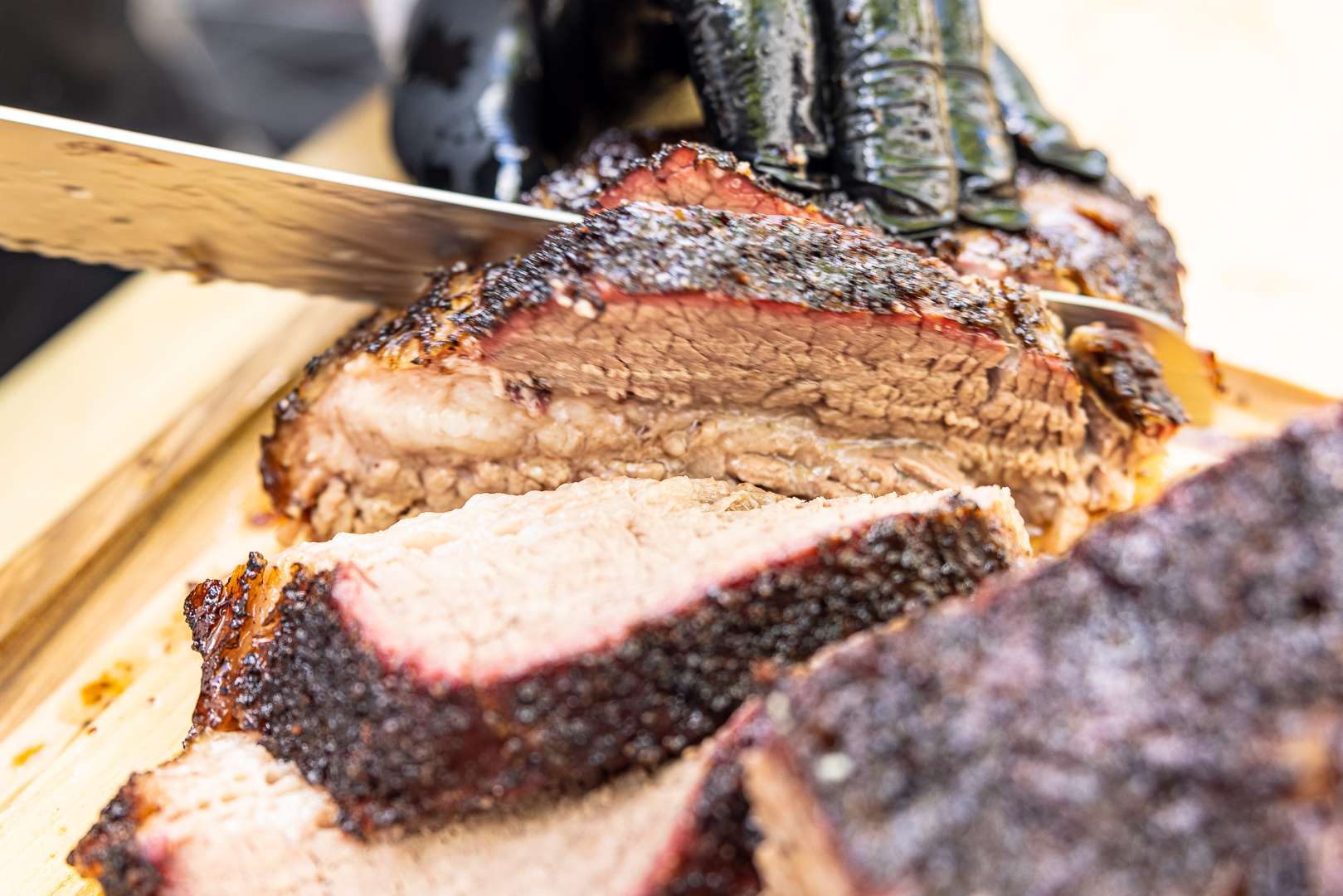
The results were positively delicious, but not quite as in-your-face tasty as the naked brisket. The flat was very good, and the point was almost as good as that of the first one. One thing that was an indication of good results was the front corner of the flat. That little bit is often overcooked and tough—like jerky almost—no matter how well the rest of the brisket was cooked. That was not the case here. Even that corner was tender and even—gasp!—rather moist.
The theory behind the paper stood up to experimentation. The bark was firm and well developed—it had not sogged away—without being hard. However, it lacked the wild-smoke flavor of the unwrapped version. It was a little tamer. Excellent brisket.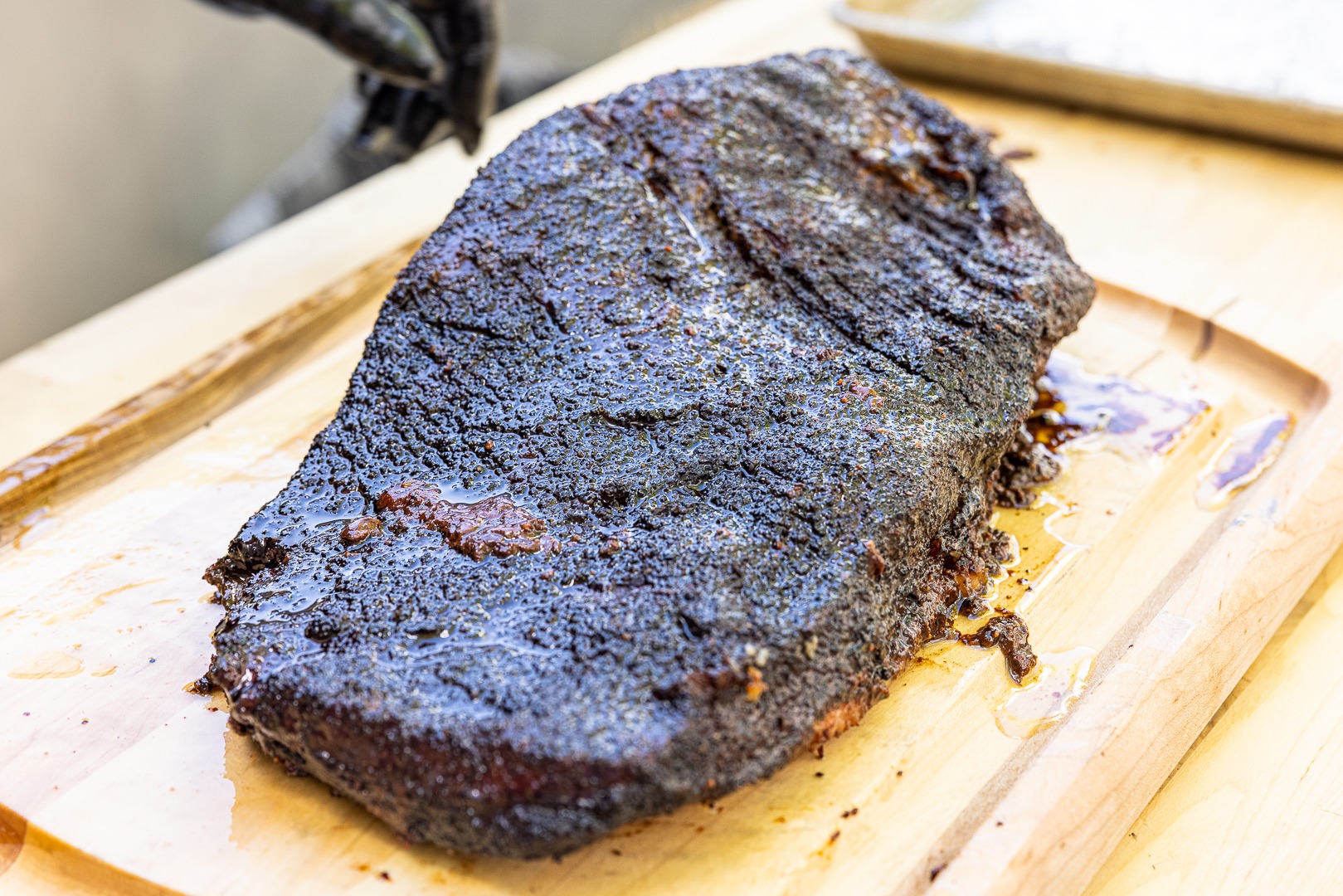
Foil brisket:
The foil-wrapped brisket took only a little over eight hours to cook. It is the speediest method we tried. If you want brisket for dinner tonight, you can put it on this morning and get there. Not so with the others!
From the data, you can see that the flat did stall a little bit, but the point basically rode a nearly straight line up temperature mountain. Not only was there no stall to speak of in the point, the temperature increase actually accelerated once we added the foil!
(I should note that before this went in for its hour of resting, we “burped” the steam out of it. We let the other two cool somewhat before resting, and this wasn’t going to cool without letting some air out, so we undid the ends of the foil and let it air out for a few minutes.)

And how did it turn out? Good. Quite good. But…
The problems here were twofold: the bark and the meat itself. The bark was not well set, despite the fact that it was well-set before wrapping. After the wrap, it was quite loose. Also, the pepper in the bark tasted more raw. We got sharp pepper flavor, but not cooked, smoked, toasted pepper flavor.

The meat was very juicy, even (especially?) in the flat, but it was chewier than we wanted it to be. Not that it was super chewy, mind you. It was still better than a lot of brisket I’ve been served at BBQ chain restaurants. The flat has a very good texture, but needed just a smidge more bend to it, and the point needed to be cut into thinner slices to be as enjoyable.

The reason for this is that collagen dissolution is a function of time as well as temperature. Getting up to 203°F (95°C) quickly didn’t give the collagen enough time in the melt zone to do all it needed to do. Giving the foil-wrapped brisket more time in the cooker beyond the time it takes to come to temperature might solve this. Even a longer rest might help.
This brisket had more of a pot-roasty feel and flavor than quality BBQ. Is it worth it, though, for the time you save?
If you were gettin’ in trouble and maybe your brisket wasn’t going to get done on time, you could wrap it in foil and really accelerate the cook time. It really comes down to taste.”
—Aaron Franklin
Brisket Conclusions
Here’s a quick rundown on the results:
| Method | Time | Bark outcome | Meat quality |
|---|---|---|---|
| Naked Brisket | 16 hours | Strong, crisp bark | Juicy, tender, amazing. Stellar quality. |
| Peach Paper Brisket | 15 hours | Quality bark | Excellent, just a hair less amazing than the naked one. |
| Foil Brisket | ~8.5 hours | Loose bark with raw pepper flavor, little smokiness | Generally a little chewy, not enough collagen breakdown. Needs more time at temp. |
Obviously, these outcomes are variable, because brisket is jazz! Every cook is an adventure. May is National BBQ month, and we hope that you’ll get out there and give brisket a try, and then tell us about your own results.
If this is your first time cooking a brisket, our recommendation is to try the naked brisket first. This will give you a baseline against which to judge your subsequent cooks and experimentation. Have the unwrapped, full-cook-time experience first, and then try messing with rubs, sauces, crutches, etc. Simplicity first, then jump into the music and start to improvise.
But no matter what way you choose to cook your brisket, be sure to monitor it with a quality thermometer! The Signals BBQ Thermometer, paired with Billows, is an excellent way to keep an eye on your brisket so you can know when to wrap it, when to poke it, and how your fire is burning. Smoked brisket is truly one of the most challenging meats to cook properly, but with the right instruments you, too, can wail with the kings of the ‘Q!
Happy cooking!


0 comments