

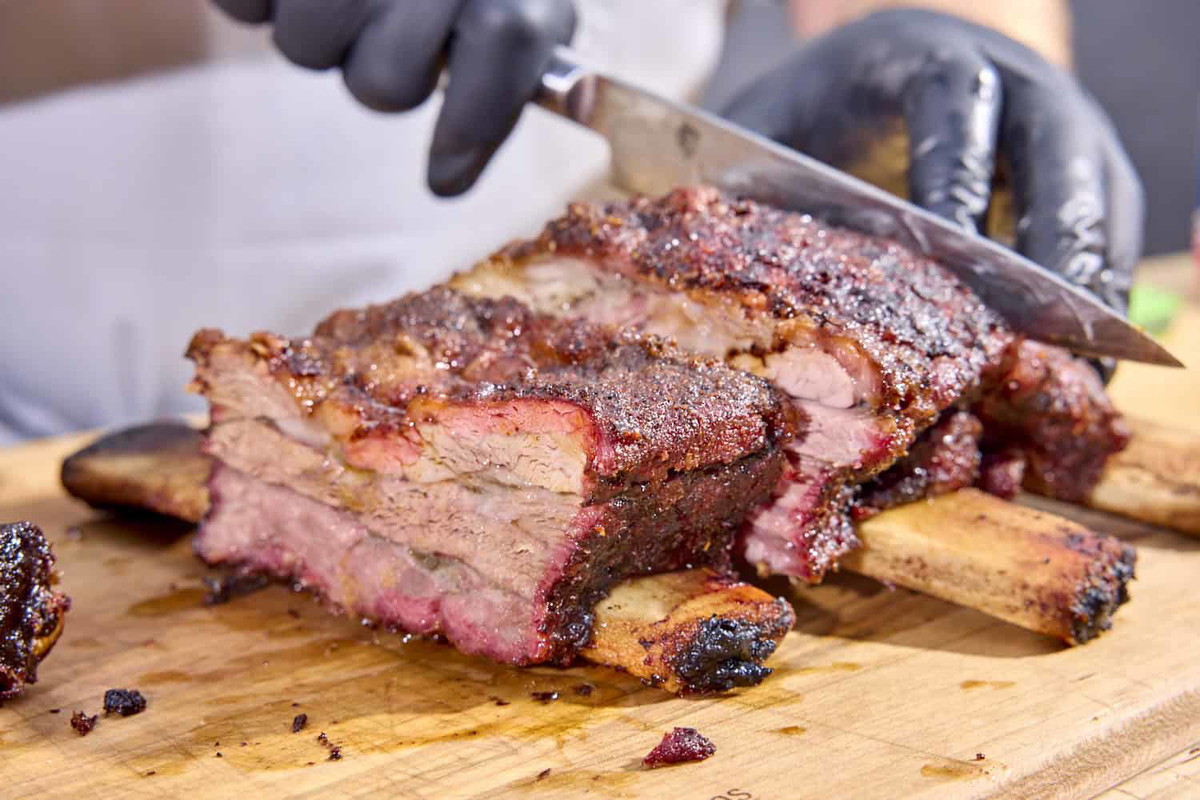
When watching cartoons as a kid, were you impressed by the rack of ribs that was served to a certain Stone-Age family at that prehistoric drive-in restaurant? Were those mammoth ribs? And how would you go about eating them? Well, butchers a long time ago came up with a solution to that problem: cut the ribs shorter. And though we don’t eat mammoth ribs anymore, we can still get a caveman-style rib experience by cooking whole plates of short ribs—what some call “Dino Ribs.”

Dino ribs get their name from their big, meaty, size. They are fat ribs with loads of meat on them. Compared to baby back ribs, they are huge! Short ribs are a classic braising meat that has found a place in BBQ under the guise of a prehistoric treat. And they are delicious. Full of beefy, smoky flavor and tender to the bone, these ribs can slake even a hearty appetite with their richness. In this article, we’ll cover what short ribs are, and how to properly smoke them for optimal results.
What are short ribs?
The first question to address is the question of short ribs themselves. “Short ribs” is butcher parlance for a partial cut of ribs from anywhere on the steer's ribcage. They can come from the areas under the brisket, chuck, rib loin, or plate. Whereas baby back ribs and spare ribs both indicate a specific position on the hog, short ribs have more to do with how they are cut than where they are cut from the steer: they are short sections of rather long bones. Some butchers will give you the option of which kind of short ribs you prefer, but generally, it’s anyone’s guess whether your short ribs are plate, chuck, loin, or brisket. Each section will have a slightly different flavor of meat and fat. But regardless of which part they come from, they are all cooked the same—and they are all delicious.

The difficulties of cooking short ribs
The cooking of short ribs is a story you have heard before if you are familiar with BBQ cookery. Ribs—being well-used, protective parts of the body—are filled with collagen. This connective tissue must be broken down by long, slow cooking to unwind into gelatin, with the unraveling beginning at 170°F (78°C), and accelerating as the temperature increases. (This is why short ribs are often cooked by braising; it’s an easy way to break down the tough connective tissues.)
As you cook up to temperatures where the collagen can melt, you'll squeeze a lot of water out of the meat. When that locked-up water is freed and starts to evaporate, you get "the stall". When the stall starts, you can either wrap your ribs and speed through it, or leave them bare for more smoke flavor and darker bark. Whichever method you choose, the point is to get those ribs to 203°F (95C°). If you get there quickly by wrapping, you’ll want to let them spend an hour or so at that temp (dissolution is a function of time and temperature), but if you take the slow road and cook them bare, they should be ready once you get to that critical temperature.

How to cook beef short ribs
Aaron Franklin, of the renowned Franklin BBQ, recommends smoking short ribs at 285°F (141°C). This slightly-higher temperature cooks the ribs more quickly, while not drying them out. A spritz or two of water or something more flavorful like apple juice during the cooking helps keep the edges tender. But one of the beautiful things about BBQ is that there is no one way to cook something. Others recommend cooking these ribs at 250°F (121°C). We opted for the lower temp on this run, though we have done it at 285°F (141°C) with excellent results. Whichever temperature you choose to use, monitor your pit and meat temps with a multi-channel BBQ thermometer like Signals.
We set our high-temp alarm for the meat probes to 160°F (71°C) and cooked up to that point. We then checked the bark, which was setting up very well, even with the one spritz we had given it. Why set the alarm to 160°F (71°C)? Because at that temperature, the stall is just starting to really get going. In the graph below you can see where the stall was going to start. At that point, we pulled the probes, wrapped the beef, and continued to cook. We also increased the smoker temp to 300°F (149°C), as the smoke flavor can't get through the wrapping anyhow.

A graph like this can be very instructive. For instance, you can see the temperature of the pit (the top line in green). Putting our air probe close to our meat meant we could get the actual air temp of the pit, not just what the pellet smoker said it was. When the temp drops the first time is when we changed the setting on the smoker from 250°F to 225°F, as it was burning 25°F hot at its set temp. You can also see where we adjusted the probe positions in the ribs to find a cooler center. The dip in temp for the yellow line at the end is where we unwrapped it and let it rest in the smoker to reset the bark a little. Without the protective foil, there was a lot of evaporative cooling that happened quickly, dropping the meat temp.

The graph was made using Signals, connected to the cloud. With the free ThermoWorks app, you can track your cook like a pro, watching the stall come and go right from your phone or smart device.
If you decide to wrap your short ribs, as we did, we recommend doing so close to the beginning of the stall, rather than using it to speed through the end of the stall. But you can, of course, leave them naked through the whole cook.

Though they take longer to cook due to their greater thickness, smoked short ribs are no harder to make than baby back or spare ribs. The key is to get them to a temperature that will melt the collagen that is binding the other proteins together—203°F (95°C).
And with Signals, you can watch the cook happening in the palm of your hand. Yes, the ribs were probably great at that Stone-Age drive-in, but the technology for cooking them is far better now!

For another look at BBQ short ribs, take a look at this post with a video from Harry Soo about his preferred method.


0 comments