

Have you ever had porchetta? You know, the classic Italian dish that dates back to Roman times, that might well have been eaten by Roman Emperors? The one where you wrap a pork belly around a stuffed pork loin and roast it until the skin crisps into pork crackling? You've never had it? Boy, are you missing out!
What is porchetta?
Porchetta (pronounced por-KEH-tah in the Italian) is an amazing example of pork cookery and one that the Italians have been loving for centuries. It is sold in sandwiches from road-side bistros and from food trucks and is brought, whole and gleaming, to the table of family celebrations. Originally, it was made from a whole side of a pig that has been deboned, rolled up, and roasted on a spit. Yum. Now it is usually made by wrapping a pork belly around a pork loin and roasting it. Still yum.
Since most of us don't have a whole side of a pig, let alone a spit on which to cook it, we're going to show you how to cook a delicious and traditionally flavored porchetta that is both juicier and far easier to make than the original. It's so tasty that it will knock the turkey right off your holiday table.
Perfect porchetta roast
A perfect porchetta roast should have:
- Tender, juicy meat
- Plenty of seasoning, much of it from fennel
- Crispy crackling that is not hard to bite into/through
A roast that meets any of those criteria will be good, but a truly excellent roast will meet all of them.
Porchetta problems
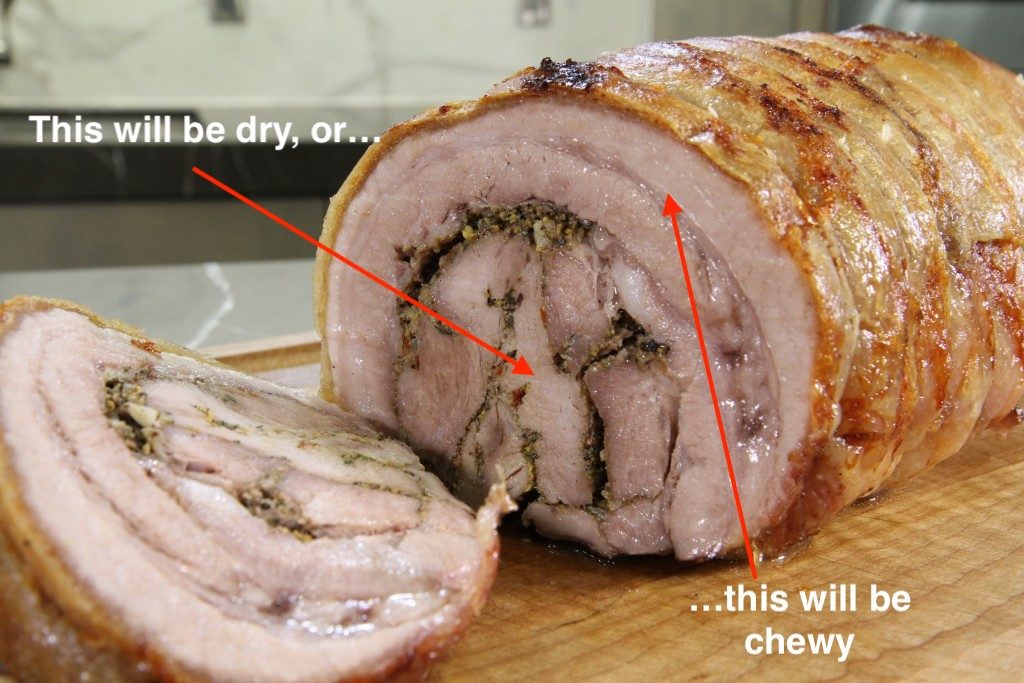
When we look at the meats involved in porchetta, we might start to see a problem. Porchetta is made of pork loin and a belly, and those two meats could hardly be more different. Loin is lean and tender with little to no connective tissue; belly is fatty and full of collagen. (Pork skin is also collagen-rich and tough.) In order to dissolve the collagen and render the fat in the belly, we'll need to cook it to at least 170°F (77°C). But a pork loin is done at 145°F (63°C), and well past done by the time it reaches 170°F (77°C). Compound that problem with the desire for crispy pork skin, and we find an irreconcilable mess.
"But!" people will say, "the fat from the belly will protect the loin from drying out!" Hogwash. It's time to put that old saw away and think about things from a thermal/scientific angle.
First, what we're trying to preserve is moisture, which is water-based. If we're concerned about our pork loin losing water, that means that water is flowing out of it, and if water is flowing out, how much chance is there that fat (oil) will be able to flow in? It can't. In fact, the idea of fat or oil penetrating into meat at all is, frankly, laughable. Oil penetrating a water-based medium? Hardly. It may coat the outside, but it will not go in, and it will not stop water from leaking out up underneath it. So the fat of the belly cannot keep the loin from drying.
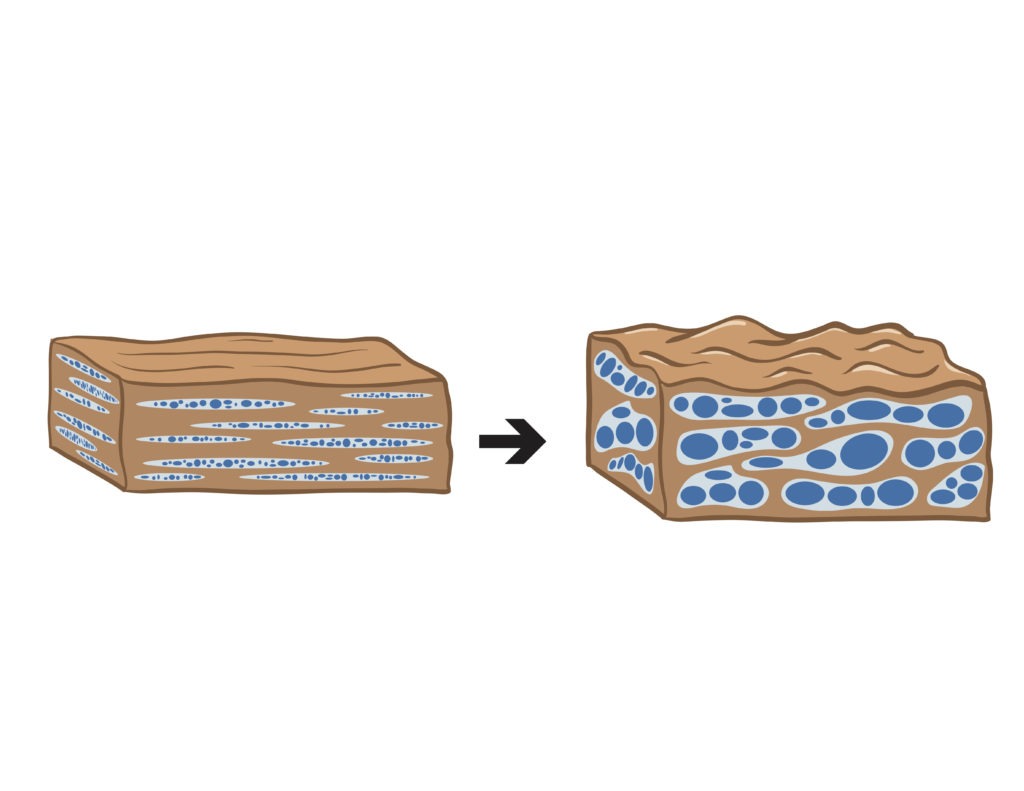
Beyond the basic oil/water problem, though, is the problem of cooking proteins. When the proteins in a pork loin are cooked as high as a pork belly needs to be, they constrict and squeeze water out from inside of them. No amount of fat-wrapping will stop those proteins from squeezing water out.
And so we see that porchetta presents us with some serious thermal challenges. J. Kenji López-Alt summarizes it well:
As the pork is ... roasted, the fatty belly portion rich in juices and connective tissues ostensibly helps keep the relatively dry loin moist.
But we all know that this isn't really how cooking works. All the fat in the world surrounding a lean, tightly textured muscle like a pork loin will not help keep it moist if you cook it past 150°F or so.SerioiusEats.com
On the other hand, belly, with its extensive network of connective tissue and abundant fat content, needs to be cooked to at least 160°F for a couple of hours in order for that tissue to slowly break down and for some of the fat to render.
And solutions...
Kenji's proposed solution is simple: leave the loin out. As solutions go, it's a winner. Is it completely traditional? No. But that's the only strike against it that I can find. Yes, an all-belly porchetta roast is technically smaller, but it's still quite large, and the richness of the meat makes it go far. In exchange for leaving the loin out, you get a shorter cook time, juicier meat, an easier preparation, and a lower cost. Win-win-win.
How to prepare an all-belly porchetta
To prepare an all-belly porchetta roast, start by deeply scoring the meat of a skin-on pork belly so that it can hold more seasoning. Then apply toasted, ground spices (the toasting brings out their flavors) to the meat and roll the whole thing up and tie it. Rub the skin with salt and baking powder to draw out the excess moisture and speed the cooking, and to help the skin puff up better when it turns to cracklings.
After a night's rest in the fridge, the belly roll is cooked at a relatively low temperature to melt the collagen slowly into gelatin. It is kept in the range of 160–180°F (71–82°C) for about two hours for that melt to happen. The fat will also render during that time, improving the juiciness and texture of the meat. Using a ChefAlarm® to track those temperatures is key to getting the final juicy/tender texture just right.

Once the meat of the belly is super tender (a poke with a Thermapen® ONE can verify both the temperature and the texture), it's time to make crackling. Remove the roast from the oven and crank the oven heat to 500°F (260°C). (Open a window because it's going to get smokey.) Put the belly in the oven to crisp. If you want to understand the crackling-making process in depth, I recommend our article on Slow-Roasted Pork Belly with Chicharrones. But suffice it here to say that collagen that has been rendered in the skin leaves behind pockets of water, and those can be turned to steam in a high oven, expanding the pockets and leaving the skin crisp.
The porchetta should be flipped over once or twice during the high-heat stage so that the bottom (seam) side can be crisped as well. The meat temp will certainly rise during this part of the cooking, but that's ok—with collagen-rich, fatty meats like this, going as high as 203°F (95°C) is just fine.
It's a long process, but not a very difficult one, and the results it yields are well worth the effort.
It takes something special for a dish to stick around for more than a thousand years, and this one really has it. But with thermal knowledge and an understanding of how meat works, you can make it better than the Romans did. In fact, with modern tools like the Thermapen and the ChefAlarm, you can get results that would make an emperor jealous. This Holiday season, ditch your old standby dishes and make something spectacular to celebrate: make porchetta.


0 comments