

It’s been about two decades since the whisperings started. “Have you heard about…” “It was because he…” “Have you tried…?” “I don’t know, it sounds weird…” And since then, people have generally been enjoying turkey more. Of course, we’re talking about brining. Yes, people had been brining turkeys for years before, but it’s been about 20 since the process started to take general hold in the public consciousness. And with good cause. Brined turkeys are more flavorful and juicier. But they’re also messy and a pain to clean up after. That’s why we’ve switched to dry brining.
Like you, we like our meat juicy and flavorful. [footnote]If you don’t like flavorful, juicy meats, this might not be the blog for you.[/footnote] So brining is something we took to early on. But the difficulty of keeping a bird below temp in a water bath overnight, then scrubbing the cooler out so we can use it for non-salmonella purposes, was a bit much. Enter the dry brine.
With a dry brine, you can get even juicier meat without all the hassle of making a brine and keeping meat cool in the watery mixture for a day or two. Oh, and you’ll also get crispier turkey skin. Interested? Let’s take a look.
What does a turkey brine do?
When people talk about brining, they most often talk about osmosis, the movement of water across water-permeable membranes. Water moves from an area of low solute concentration to an area of high solute concentration. Think of it as Nature seeking balance. If area x has one part salt and two parts water, and area y has pure water, water will flow from y into x in an attempt to create equal concentrations.
The (folk-) theory behind brining is that turkey cells have all sorts of solutes (minerals and proteins, for instance) and that bathing them in a salt-sugar solution will encourage water to move across that membrane, bringing with it some of the salt and sugar to season the meat. The result, supposedly, is that the meat ends up juicier.
In truth, this is not what happens.
If it were, then soaking a turkey in pure unsalted water should be more effective than soaking it in a brine ... Moreover, if you soak a turkey in a ridiculously concentrated brine ... according to the osmosis theory, it should dry out even more. —Kenji, pg 575
Kenji is, as always, correct. Osmosis would take water OUT of the turkey to lower the salt concentration in the water.
So, what is really happening when we brine? Salt action. Before we explain, let’s talk about what happens when we cook meat.
In our post Heat and Its Effects on Muscle Fibers in Meat, we showed that myosin denaturation is responsible for most moisture loss in meat: When the myosin molecules in protein fibers shrink under heat, they squeeze water out of the muscle fibers.
When myosin contracts, water is expelled. By dissolving it, we retain moisture.
This is where the salt comes in. A 5.5% solution of salt actually allows myosin filaments to dissolve, preventing later coagulation. If myosin can’t coagulate, then it can’t get as tough when cooked, and it also can’t squeeze as much water out of the protein fibrils, allowing them to retain moisture better. So, treating meat with salt promises tender, juicier meat.
“Yes,” you say excitedly, “that’s why I should brine my meat in salty water!”
“No,” science frowns back at you, “that’s not what I said.”
Disadvantages of a traditional turkey brine
If we look carefully at what’s happening, we see that the salt is actually doing the work, not the water. In fact, the brine solution itself has some distinct disadvantages. One is that it is literally watering down your meat. By bringing water into the meat, you are diluting its natural flavor, making densely packed amino acids more scarce per gram of food. Not good.
... brining robs your bird [or meat] of flavor. Think about it: The turkey is absorbing water and holding on to it. That 30 to 40 percent savings in moisture loss is not really turkey juices—it’s plain old tap water. Many folks who eat brined birds have that very complaint: it’s juicy, but the juice is watery.
—The Food Lab by J. Kenji López-Alt (pg. 576)
Of course, another disadvantage is that it’s a royal bother. Brine solutions are heavy and messy and raw turkey brine is not something you really want contaminating your kitchen.
And then there’s the skin! We’ve all looked at our fingers when we get out of the bath/swimming pool. To crisp turkey skin, we first have to cook all of its water out. So filling the skin with extra water before we cook isn’t going to help anything.
Why dry brine is better
So now we arrive at the advantages of a dry brine. Dry brining could just as easily be called “salting,” which it is. (But that has connotations of preserving and drying that we’re trying to avoid). The salting/dry brining process accomplishes everything good that a wet brine does. As the Cook’s Illustrated Meat Book describes:
When salt is applied to raw meat, juices inside the meat are drawn to the surface. The salt then dissolves in the exuded liquid, forming [its own] brine that is eventually reabsorbed by the meat. The salt changes the structure of the muscle proteins, allowing them to hold on to more of their own natural juices.
—Cook's Illustrated Meat Book (pg. 5)
So there you have it. Dry brining is the perfect solution for both dissolving myosin and retaining more of the natural juices of your turkey. It's like having your cake and eating it, too (except in this case, you're eating turkey).
How long to dry brine your turkey (or other meat)
The concepts involved with dry brining a turkey apply to other meats, as well. (Though, obviously, a steak doesn’t have crispy turkey skin to improve.) But the protein dissolution applies as well to pork loin and bison as it does to turkey and chicken. So how long does a dry brine need to last?
To dry brine a piece of meat, rub it well with kosher salt and give it a rest. The time needed for the process varies based on what the meat is. Below we’ve recreated a table from the Cook’s Illustrated Meat Book explaining the amount of salt and the time needed to dry brine various meats. A timer like the TimeStick can help you keep track of your dry brine.
| Cuts | Time | Kosher salt | Method |
| Steaks, Lamb Chops, Pork Chops | 1 hour | ¾ tsp per 8-ounce chop or steak | Apply salt evenly over surface and let rest at room temp, uncovered, on wire rack set in a rimmed baking sheet. |
| Beef, Lamb, and Pork Roasts | At least 6 hours or up to 24 hours | 1 teaspoon per pound | Apply salt over surface, wrap tightly with plastic wrap, and let rest in refrigerator. |
| Whole Chicken | At least 6 hours or up to 24 hours | 1 teaspoon per pound | Apply salt evenly inside cavity and under skin of breasts and legs and let rest in refrigerator on wire rack set in a rimmed baking sheet. (Wrap with plastic wrap if salting for longer than 12 hours.) |
| Bone-in Chicken Pieces; Boneless or Bone-in Turkey Breast | At least 6 hours or up to 24 hours | ¾ teaspoon per pound | If poultry is skin-on, apply salt evenly between skin and meat, leaving skin attached, and let rest in refrigerator on wire rack set in a rimmed baking sheet. (Wrap with plastic wrap if salting for longer than 12 hours.) |
| Whole Turkey | 24 to 48 hours | 1 teaspoon per pound | Apply salt evenly inside cavity and under skin of breasts and legs and let rest in refrigerator, uncovered. |
And Harold McGee further adds:
Because the brine works its way in from the outside, it has its earliest and strongest effects on the meat region most likely to be overcooked, so even a brief, incomplete soaking can make a difference.
—On Food and Cooking, pg. 156
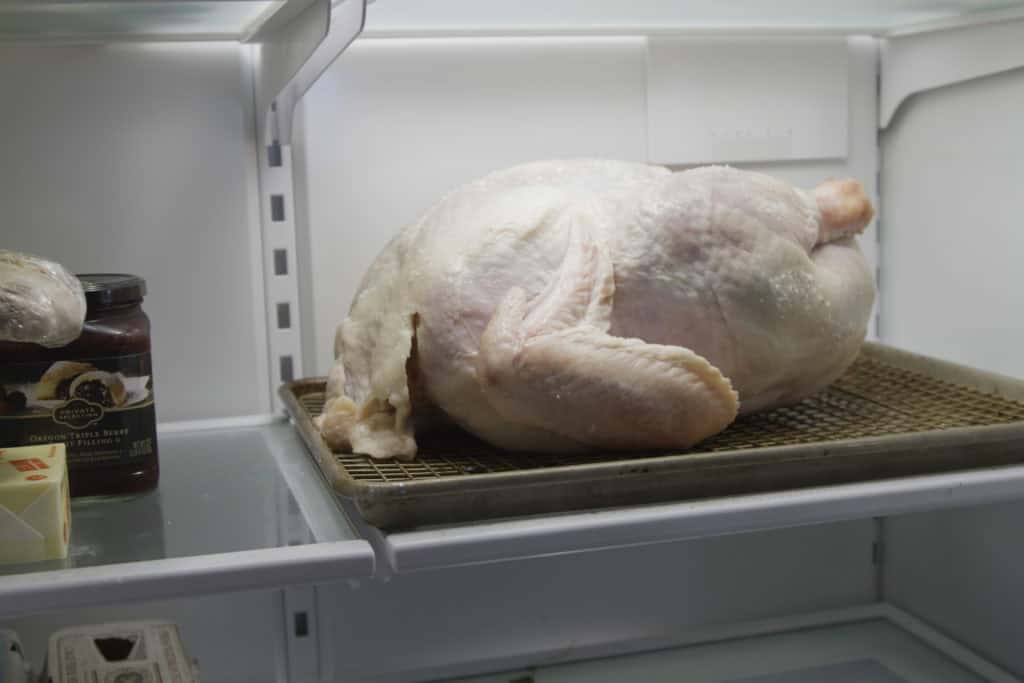
This table reflects the significance of the idea that the salt—drawing out juices—creates a natural brine. Kenji López-Alt, however, recommends putting chickens and turkeys in the fridge without wrapping them, noting that a crispier skin will result from the skin being able to dry out overnight.
To dry brine a bird, first carefully loosen the skin ... Then rub about 1 teaspoon of ... kosher salt per pound of meat all over its body, under its skin. Place the bird on a rack set over a large plate or rimmed baking sheet and refrigerate uncovered, overnight (or for up to 48 hours if using a turkey). The next day, cook as directed, skipping or going light on the seasoning step. —The Food Lab by J. Kenji López-Alt (pg. 579)
In our experience, leaving meat open to the air in the fridge yields excellent results. (We followed this method, for instance, in a post on How to Make Fried Chicken.) The brine created by the extracted juices still rests on the surface of the meat before being reabsorbed (or evaporating off).

Wrapped or not, by salting the meat directly, it is easy to achieve the 5.5% salt solution in the meat that is necessary for partial filament and protein structure dissolution (On Food and Cooking by Harold McGee, pp. 155-156). That means more tender, juicier meat!
If you’re concerned about losing the flavor you were hoping to get from your brine, don’t be. You can make a rub with a high salt content and use that on your meat for the dry brine. This will give the flavors time to soak in and you will actually get a more direct, pronounced flavor from them than in the wet brine. This Thanksgiving, give dry brining a try. Or try it on your Christmas roast! A dry brine is miles easier than—and every bit as effective as—a wet brine. No buckets needed, and you still get the protein-dissolving power of salt to make your meat juicier, more tender, and plain tastier. Happy cooking!
References:
Harold McGee, On Food and Cooking: the Science and Lore of the Kitchen
J. Kenji López-Alt, The Food Lab
America's Test Kitchen, The Cook's Illustrated Meat Book


0 comments