

People tend to get a little hyperbolic about steak. It's easy to bite into a properly cooked steak from good quality meat and declare "this is the best steak I've ever eaten." I've said it for at least 15 steaks. And it was true of all of them. In fact, the best steak you've ever had can be the steak right in front of you every time, if you know how to cook it right!
That's why my go-to steak is usually the New York Strip. Of course, I sometimes splurge and get the über-tender filet mignon or the rich and meaty ribeye, but time and time again, I reach for the strip and walk away happy. Why? because beefy flavor that is cooked properly and has those delicious Maillard-reaction flavors is great no matter how expensive the cut. In today's post, we'll go over how to grill a New York strip to perfection, with a thermal explanation of the process.

Strip steak: what is it?
The strip steak is from the strip loin (a section of the short loin) of the steer. The short loin lies behind the ribs and includes the strip loin and the tenderloin, as well as the bones between those two cuts. A T-bone or a porterhouse steak is a whole cross-section of the short loin, the NY strip is a cross-section of the strip loin, while a Kansas City strip is a NY strip with the bone on (a T-bone minus the tenderloin).
This group of muscles, much like the rib loin, is seldom used by the cow—which means it has less connective tissue and is naturally more tender than cuts from, say, the legs or the breast of the animal (i.e. the round or the brisket). That's why they make good steaks: they can cook quickly and don't need to be heated to collagen-melting temperatures to make them chewable. That's why they're so tasty medium-rare or medium—130–135°F (54–57°C) or 135–145°F (57–63°C).
How to grill a New York strip steak
How to grill a NY strip depends in part on its thickness. If you have a thick, thick steak (greater than 1.5 inches), you need to cook it with a two-stage method, preferably with a reverse sear. The reason for this lies in the temperature gradients. If you were to cook a large steak over direct high heat, there would be so much heat pumping into the steak's edges that by the time you get the center of your steak up to your pull temp, the outside of the steak will be overcooked and dry. Bringing the steak slowly up to temp decreases the range of the temperature gradations, allowing you to bring the center temperature up to the proper level without overcooking the exterior.
However, if your steaks aren't too thick (less than 1.5 inches), you can go ahead and cook them over direct heat without too much worry. Mind you, you'll need to attend to them and monitor their temperature carefully with a fast and accurate thermometer, like Thermapen ONE, but you can certainly go for the direct sear. Direct heat cooking is best done with lots of flipping (you can read all about that in this post).

But in this case, we opted for a two-zone cook (which is best for larger, thicker steaks). We started with some strip steaks which we salted and peppered. We placed them on the indirect-cooking side of the grill, probed with an optional 2.5" needle probe attached to a ChefAlarm with the high alarm set to 100°F (38°C).
When the slow-cooking steaks reached the target 100°F (38°C), we removed the probe (they aren't suited to the kind of high-heat grilling we were doing) and moved them to the direct heat side. We monitored them by testing occasionally with our Thermapen ONE until they reached the pull temperature for medium, 125–130°F (52–54°C).

When we pulled them and cut them open—after allowing them to rest— we found them to be a nice medium-rare.
Fast-cooked steaks will have a bit of a better crust on them, which is desirable for many eaters, despite a slightly greyer edge. But if more even doneness matters more, the two- zone method is the way to go. You can choose how you cook yours, depending on your desired final result and on how much time you have to cook.

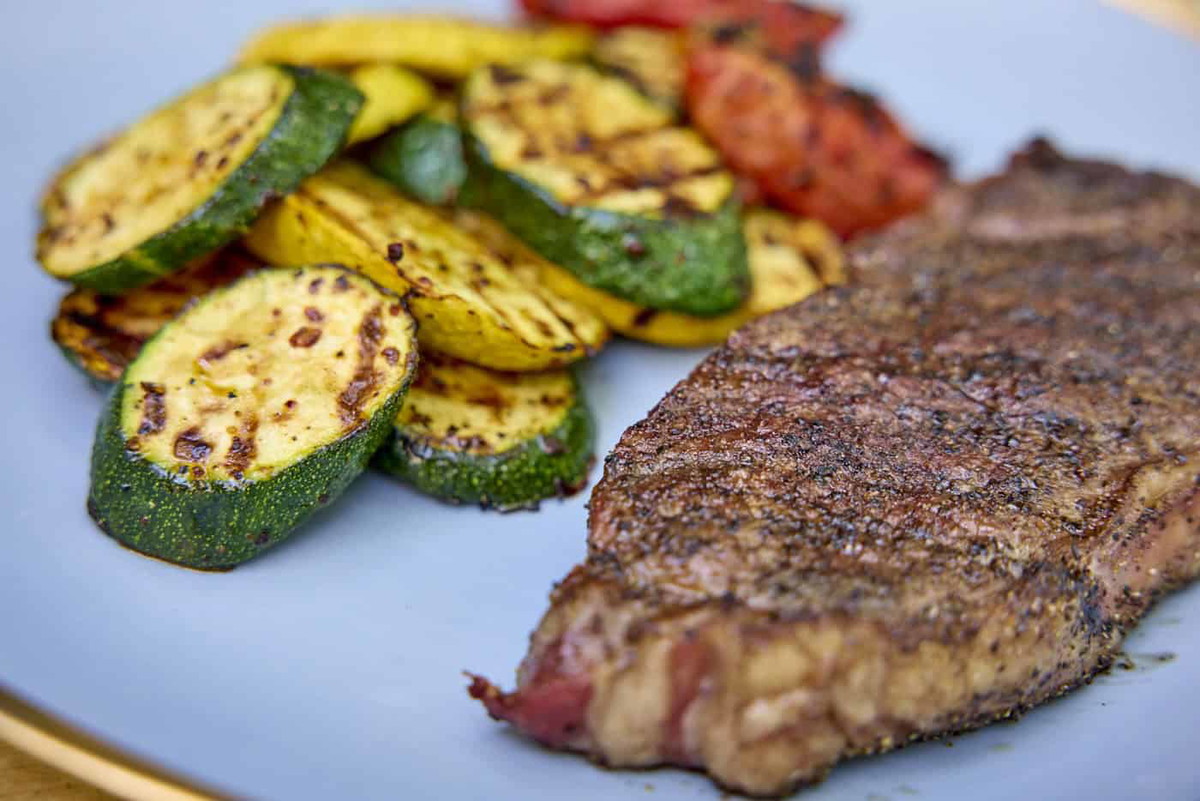
Below is a recipe for the steaks—cooked both ways—and we've thrown in some simple grilled veggies to round the dinner out.
Serve the steaks with the grilled vegetables and enjoy the taste of summer. How you choose to cook them don't matter at this thickness. Ultimately, both methods work very well—it's just a matter of how you want your cooking experience to go. If you have a lot of steaks to cook, starting them all slow and then finishing them quickly can take a lot of stress off, while allowing you to leisurely sip a beverage of some kind while you wait. If you want a little bit more crust on your steak, direct heat may be for you.
And while the ribeye may be the king of steaks and filet the king/emperor, there is still nobility aplenty in the classic New York Strip. Will a properly cooked NY strip be the best steak you've ever eaten? It won't be the tenderest (filet) or the richest (ribeye) or the manliest (porterhouse), but if you cook it right and control the doneness with a fast and accurate thermometer, like Thermapen ONE, you aren't going to care about those other steaks. You're going to be too busy enjoying the best steak you've ever eaten right now.


0 comments