

Sometimes you want brisket, but you don't want 8–16 hours of cooking. What are you to do? Well, let's talk about Brisket-Style Tri-Tip. The internets are all a-buzz these days with the idea of purposefully "over"-cooking tri-tip up to brisket doneness temps. When we heard about it, we were suspicious. We watched Malcom Reed cook it, and we watched Susie Bulloch cook it, and we respect their BBQ credentials like mad. But we wondered if even they were caught up in some kind of "The Tri-Tip's New Clothes" excitement.
No, they had not.
Brisket-style tri-tip is not only 98% as good as a brisket, it is, in many applications, far better than medium-rare tri-tip. Here, we'll go over the thermal processes and critical temps you need to re-create this amazing dish at home, with success from the get-go. We're pretty sure this may become your go-to BBQ beef dish for smaller parties and cookouts.

Why cook tri-tip like brisket?
We love brisket, and we love cooking it. The challenge, the waiting, the expectation—it's so fun! And the results are perfect for a party of friends and neighbors. But it's not cheap. And it does take a long time to cook.
But what if we could get excellent brisket for a fraction of the cost, in a fraction of the time, without any trim waste? And what if we didn't end up with several pounds of leftovers to vacuum seal after a simple family dinner? All of these things are possible if we make one simple substitution in our brisket cook: sub in tri-tip for the brisket.
How could this be any good? After all, tri-tip is a steak-like cut, right? Isn't medium rare the best way to cook it? I've had dried-out, overcooked steak and it was not good. How could cooking tender tri-tip way past well-done possibly be good?
Yes, tri-tip is considered a steak-like cut and is usually served medium or medium-rare. It's amazing on its own like that, but when you put it in a sandwich, it's … less fun. You see, for something that is steak-like, there's quite a bit of connective tissue in the tri-tip. And that means that there's a lot of pulling and ripping and meat falling out of the bread and disappointment.
But when made with this style of tri-tip, BBQ sandwiches are quite perfect. The meat pulls easily apart, it is plenty juicy from the dissolution of what connective tissue there was, and its texture is phenomenal.

How to make brisket-style tri-tip
The process for brisketing your tri-tip is simple, but it needs careful monitoring and temperature control. We opted for a little more speed in our cook by smoking at 250°F (121°C) the whole time. If you have a pellet grill, as we used for this cook, set up your RFX GATEWAY or Smoke X2™ to monitor the temperature. Yes, a pellet smoker keeps a "constant" temperature, but it never hurts to make sure that it actually falls within the temperature range it's supposed to, and look out for fuel outages.


The seasoned tri-tip is placed in the smoker and cooked for two hours to create a smoke ring, impart smoke flavor, and help form up the bark. After two hours the bark should be well-set and the meat should be about 160°F (71°C). If it gets to 160°F before the two hours have run their course, don't worry, it will stall out and hold its temp somewhere in that range.


Once the bark is set, it's time to wrap. Using pink butcher paper, wrap your tri-tips and put them back in the smoker, and increase the smoker's temperature to 275°F (135°C). Now we start monitoring the meat's internal temperature in earnest. We're shooting for about 200°F (93°C) on this cook, so set your meat channel's high-temp alarm for 200°F. Why not 203°F ( 95°C)? Because we don't have as much collagen to dissolve in tri-tip as we do in brisket.


Cook the tri-tip until the internal temperature reaches 200°F (93°C). This should take about 3 more hours. Verify the doneness and the tenderness with your Thermapen® ONE and if you don't have any cold spots and the meat is tender, get it off the heat. A rest is a good idea here, but 15 minutes or so should do the trick. Unwrap the tri-tip and slice it up.
Results
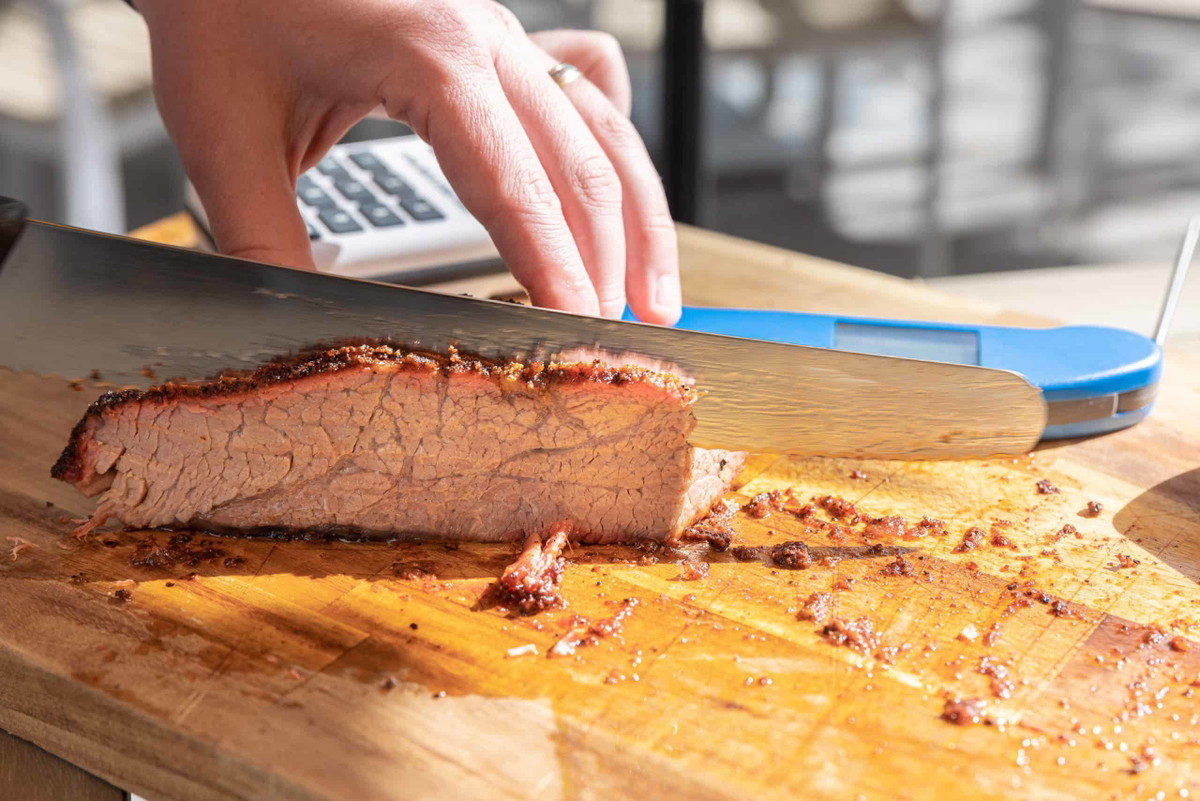
When we sliced into our tri-tip we found meat that was soft, yielding, beefy, well seasoned, and oh-so-tender. It held together just enough for the finger-bend test, and pulled apart easily with the slightest tug of the teeth. Cutting into the lateral-slicing part of the meat (tri-tip has to be sliced in two directions) gave us pieces that are almost indistinguishable from brisket. The fat seams were beautifully rendered and the connective tissue that usually gives tri-tip the toughness/chewiness that it does have was gone. Blindfold me and ask if I'm eating brisket, there's a good chance I'll say yes, and that it's excellent brisket.

How important is temperature in this process?
We cooked two tri-tips in this cook and, for some reason, one of them only got up to about 170°F (77°C). We wondered if being well overcooked, but still underdone for brisket, would yield the same results. It did not. The meat was chewy, dry-feeling, and just not good. Getting all the way up to 200°F (93°C) really matters, so don't forget to probe the meat while you cook it!
(This also goes to show that temp matters more than time. The two pieces were fairly similar in size and were put on the smoker at the same time, but one was nowhere near done when the other was ready.)
The lesson here is plain: if you're going to overcook your tri-tip, really go for it. But go for it with purpose, intent, and care. If you do, and you get it all the way up to 200°F (93°C) you'll be rewarded with smoked meat that is almost indistinguishable from some of the best briskets I've ever eaten. Try it out this weekend, you'll love it. Happy cooking!


0 comments